 editer@organickheti.in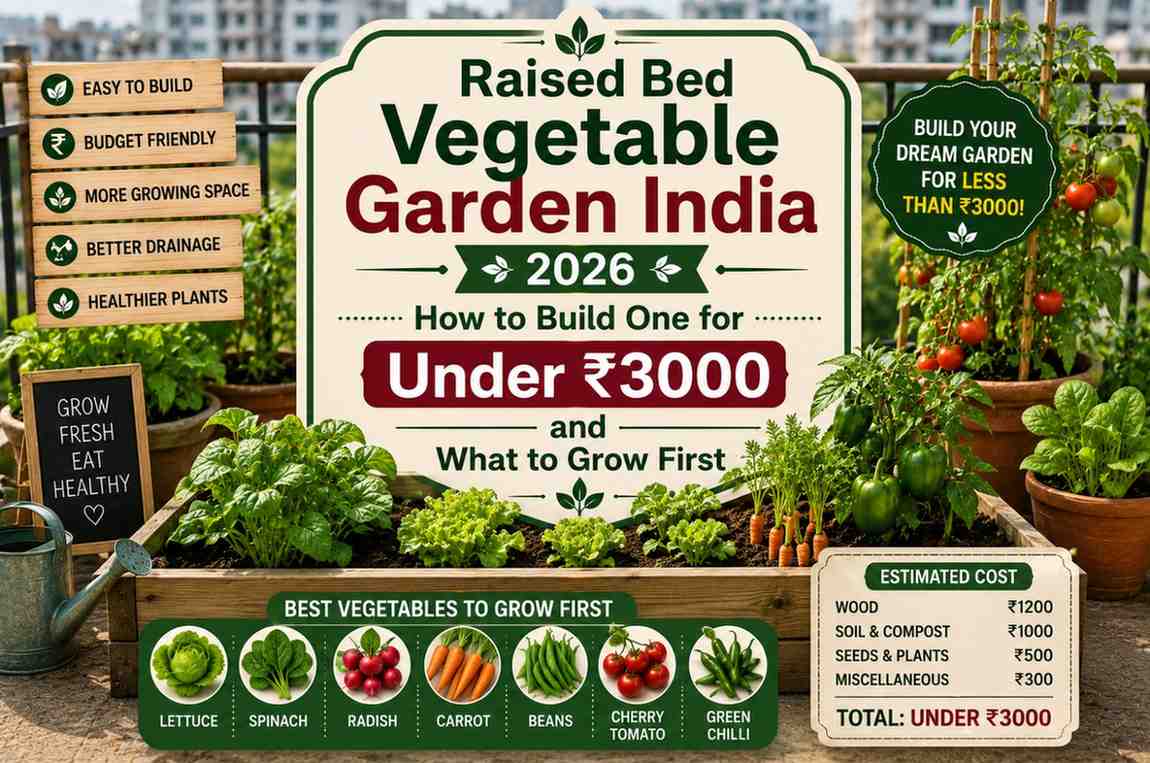
A raised bed vegetable garden India 2026 is one of the smartest investments a home gardener can make. It looks great, produces abundantly, is easy to manage, and solves every problem that flat-ground gardening creates — poor soil, waterlogging, back pain from bending, weed invasion, and unpredictable drainage.
The best part? You do not need a carpenter, a big budget, or a large outdoor space. A fully functional raised bed vegetable garden India 2026 can be built in a single afternoon for under ₹3000 — and it will produce fresh vegetables for your family for years.
This guide walks you through everything: planning your raised bed, choosing the right materials, building it step by step, filling it with the perfect soil mix, and planting the best vegetables to grow first in your raised bed vegetable garden India 2026.
National Horticulture Board India — Official seasonal growing and kitchen garden guidance
Why a Raised Bed Is Better Than Growing in the Ground in India
Before we get into the build, it is worth understanding why a raised bed vegetable garden India 2026 outperforms traditional flat-ground or container growing in almost every way.
Better Soil Control
Indian garden soil is highly variable — often too clayey in some regions, too sandy in others, and compacted nearly everywhere in urban areas. A raised bed lets you fill it with a perfectly balanced growing medium entirely of your own making. Your plants never have to struggle with bad native soil.
Superior Drainage
Waterlogging during the monsoon is one of the most destructive forces in Indian vegetable gardening. A raised bed vegetable garden India 2026 sits above the surrounding ground level, so excess water drains away naturally. Roots stay healthy even during heavy July rains.
Fewer Weeds
Raised beds filled with fresh soil mix have far fewer weed seeds than native garden soil. The ones that do appear are easy to pull from the loose, aerated medium.
Higher Yields
The deep, rich, well-aerated soil of a raised bed vegetable garden India 2026 allows roots to grow deeper and wider than in compacted ground or small pots. More root space means more plant growth, more fruit production, and dramatically higher yields per square foot.
Easier Maintenance
Working at a raised level reduces bending and strain. Watering, planting, weeding, and harvesting are all more comfortable — especially for older gardeners or those with back problems.
Pest and Soil-Borne Disease Control
Filling a raised bed with fresh, quality soil means you start with no soil-borne pathogens or pest eggs. Adding neem cake to the mix gives further protection in a raised bed vegetable garden India 2026.
IARI New Delhi — Research-backed vegetable variety and soil management advice
Planning Your Raised Bed — Size, Location, and Orientation
Good planning is the foundation of a successful raised bed vegetable garden India 2026. Before buying any materials, decide on these three things.
Ideal Raised Bed Dimensions for India
| Dimension | Recommended Size | Why |
|---|---|---|
| Width | 90–120 cm (3–4 feet) | Allows you to reach the centre from either side without stepping in |
| Length | 180–300 cm (6–10 feet) | Long enough to be productive; short enough to manage easily |
| Height | 30–45 cm (12–18 inches) | Enough root depth for most vegetables; higher for root crops |
The most popular size for a raised bed vegetable garden India 2026 is 4 feet wide by 8 feet long by 12 inches deep — this gives you 32 square feet of growing space and fits neatly on most Indian terraces and backyards.
Best Location
- Sunlight: Choose the spot that receives the most direct sunlight on your terrace or in your garden. Minimum 5–6 hours of direct sun is needed for most vegetables.
- Water access: Position your raised bed near a water source — carrying heavy watering cans across a large terrace quickly becomes exhausting.
- Wind protection: In exposed terraces, consider positioning the bed near a wall or parapet that gives some wind shelter without blocking sunlight.
- Level surface: Ensure the ground beneath is reasonably level so your raised bed sits evenly.
Ugaoo Blog — India-specific raised bed and kitchen garden guides
Materials for a Raised Bed Under ₹3000
This is the complete materials list for building a standard 4×8 foot raised bed vegetable garden India 2026 for under ₹3000.
Option 1 — Wood (Most Popular and Attractive)
| Material | Quantity | Estimated Cost |
|---|---|---|
| Untreated pinewood planks (6 inch x 1 inch x 8 feet) | 6 planks | ₹800–₹1000 |
| Corner posts (2×2 inch wooden posts, 18 inches long) | 4 posts | ₹150–₹200 |
| Galvanised screws (2.5 inch) | 1 box | ₹80–₹100 |
| Tarpaulin or plastic sheet (for base lining) | 1 sheet | ₹100–₹150 |
| Total | ₹1130–₹1450 |
Remaining budget (₹1550–₹1870) goes toward soil mix ingredients — which is actually the more important investment in a raised bed vegetable garden India 2026.
Option 2 — Bricks and Cement (Permanent and Durable)
For a permanent raised bed vegetable garden India 2026, brick construction is excellent. It is more durable, better insulated, and requires no wood treatment.
| Material | Quantity | Estimated Cost |
|---|---|---|
| Common bricks | 60–80 bricks | ₹600–₹800 |
| Cement and sand (small bag) | 1 bag cement | ₹400–₹500 |
| Mason labour (half day) | — | ₹400–₹600 |
| Total | ₹1400–₹1900 |
Option 3 — Cinder Blocks / Hollow Blocks (Fastest Build)
Cinder blocks require no cement for a semi-permanent raised bed — simply stack them two high. This is the fastest way to build a raised bed vegetable garden India 2026.
| Material | Quantity | Estimated Cost |
|---|---|---|
| Cinder/hollow blocks (8x8x16 inch) | 16–20 blocks | ₹800–₹1200 |
| Total | ₹800–₹1200 |
No tools, no labour, no cement needed. Stack the blocks in a rectangle, line the inside with plastic sheeting, fill with soil mix, and plant.
Step-by-Step Build Guide — Wooden Raised Bed
Here is the complete construction process for the most popular wooden raised bed vegetable garden India 2026.
Tools You Need
- Hand saw or circular saw (or ask the lumber yard to pre-cut)
- Drill or screwdriver
- Measuring tape
- Pencil
- Level (optional but helpful)
Step 1 — Cut Your Wood
Have the lumber yard cut your planks to size if you do not have a saw:
- 2 planks at 8 feet (long sides)
- 2 planks at 4 feet minus 2 inches (short sides, accounting for corner post thickness)
If building 12-inch deep sides, use two 6-inch planks stacked for each side.
Step 2 — Assemble the Frame
Stand the corner posts vertically at each corner. Attach the long side planks to the outside of the corner posts using 2–3 screws per plank. Then attach the short side planks. Check that the frame is square by measuring diagonally corner to corner — both diagonals should be equal.
Step 3 — Line the Base
Place your assembled frame in position. Line the interior base and lower sides with tarpaulin or heavy plastic sheeting. This slows moisture loss at the base and prevents soil from washing out while still allowing drainage. If your raised bed sits on soil (not concrete), you can skip the lining or use weed-suppressing fabric instead.
Punch or cut a few small drainage holes in the plastic lining at the base if placing on a sealed terrace — standing water at the base will rot roots.
Step 4 — Add a Drainage Layer
Before adding soil, place a 2–3 inch layer of coarse material at the base of your raised bed vegetable garden India 2026:
- Broken terracotta pot pieces
- Coarse gravel
- Coconut husk or dry leaves (these also slowly decompose and improve soil)
This layer prevents the soil mix from compacting at the base and ensures water drains freely.
Step 5 — Fill with Soil Mix
Now fill your raised bed with the growing medium. The ideal soil mix for a raised bed vegetable garden India 2026 is described in full in the next section.
Krishijagran — Indian horticulture and home gardening news
The Perfect Soil Mix for a Raised Bed Vegetable Garden India 2026
The soil you fill your raised bed with is more important than the structure itself. The perfect mix for a raised bed vegetable garden India 2026 balances nutrition, drainage, moisture retention, and biological activity.
The Recommended Mix (Per 100 Litres of Volume)
| Component | Proportion | Purpose |
|---|---|---|
| Cocopeat | 30% | Moisture retention and aeration |
| Vermicompost | 25% | Nutrition, beneficial microbes |
| Well-rotted cow dung compost | 20% | Structure, slow-release nutrients |
| Garden/red soil | 15% | Minerals, weight, natural microbiome |
| Coarse river sand or perlite | 10% | Drainage, prevents compaction |
Optional additions per raised bed:
- 2 handfuls of neem cake powder — pest and disease prevention
- 1 handful of bone meal — phosphorus for strong root development
- 1 cup of wood ash — potassium for flowering and fruiting crops
Mix all components thoroughly on a tarpaulin before filling. A standard 4x8x1 foot raised bed holds approximately 300–350 litres of soil mix.
Estimated Soil Mix Cost
| Item | Quantity | Cost |
|---|---|---|
| Cocopeat (compressed brick) | 3 bricks (5 kg each) | ₹450–₹600 |
| Vermicompost | 10 kg | ₹300–₹400 |
| Cow dung compost | 10 kg | ₹150–₹200 |
| River sand | 20 kg | ₹100–₹150 |
| Garden soil | 15 kg | Free or ₹50–₹100 |
| Neem cake | 500 g | ₹80–₹100 |
| Total soil mix cost | ₹1080–₹1550 |
Combined total (bed + soil): ₹2210–₹3000 — well within the ₹3000 target for a productive raised bed vegetable garden India 2026.
What to Grow First in Your Raised Bed Vegetable Garden India 2026
Now the most exciting part — what to plant. The best first crops for a raised bed vegetable garden India 2026 are chosen for high yield, ease of growing, and speed to harvest.
Winter First Plantings (October–November)
If you are setting up your raised bed vegetable garden India 2026 in the cooler months, start with:
Row 1 (back, tallest): Tomatoes (2–3 plants, staked) Row 2 (middle): Spinach and Fenugreek (direct sow, dense) Row 3 (front, shortest): Coriander and Radish (direct sow) Edges: Marigolds (natural pest repellent and pollinator attractant)
This combination gives you:
- Leafy greens ready in 25–30 days
- Radishes ready in 30–35 days
- Tomatoes ready in 60–70 days
- Marigolds blooming throughout, keeping pests away
Summer First Plantings (March–May)
For a raised bed vegetable garden India 2026 set up in summer:
Back row: Okra (3–4 plants) or Bottle Gourd (with trellis behind the bed) Middle row: Amaranth (direct sow) Front row: Spring Onion and Cluster Beans Edges: Basil (repels insects; thrives in heat)
Monsoon First Plantings (June–August)
Back row: Ridge Gourd or Bitter Gourd (on trellis) Middle row: Spinach and Amaranth Front row: Spring Onion and Coriander (in sheltered monsoon areas)
Balcony Garden Web — Raised bed and container gardening techniques for small spaces
Spacing Guide for Raised Bed Planting
Raised bed gardening uses intensive spacing — plants are placed closer together than in traditional row gardening because the deep, rich soil supports denser planting.
| Vegetable | Spacing in Raised Bed |
|---|---|
| Tomatoes | 45–60 cm apart |
| Okra | 30 cm apart |
| Spinach / Methi | 10–15 cm apart |
| Radish | 8–10 cm apart |
| Coriander | Broadcast sow (scatter densely) |
| Chilli / Brinjal | 40–45 cm apart |
| Cucumber / Gourd | 45–60 cm (train vertically) |
| Peas / Beans | 15–20 cm apart |
Watering a Raised Bed in Indian Conditions
Raised beds drain faster than ground soil — which is excellent for plant health but means more attentive watering is needed, especially in Indian summer.
Watering Tips for Your Raised Bed Vegetable Garden India 2026
- Check moisture daily — push a finger 2 inches into the soil; water when it feels dry at that depth
- Water at the base — direct water to the soil, not the leaves
- Morning watering — always preferred; foliage dries during the day
- Mulch the surface — apply a 2–3 inch layer of dry leaves, straw, or cocopeat on the soil surface to dramatically reduce evaporation
- Drip irrigation — if you have a large raised bed or multiple beds, a simple drip system (available online for ₹800–₹1500) is the most efficient watering solution for a raised bed vegetable garden India 2026
Seasonal Maintenance Calendar for Your Raised Bed
| Month | Key Tasks |
|---|---|
| October–November | Plant winter crops; add fresh compost layer |
| December–January | Harvest leafy greens; feed tomatoes with potassium fertiliser |
| February | Harvest winter crops; prepare bed for summer |
| March–April | Sow summer crops; add fresh vermicompost; mulch heavily |
| May–June | Monitor water daily; harvest summer crops |
| July–August | Monsoon crops; check drainage; reduce watering |
| September | Clear monsoon crops; rest bed or add green manure |
Show Image ALT text: raised bed vegetable garden India 2026 — overhead view of productive raised bed with multiple vegetable crops
Long-Term Care — Keeping Your Raised Bed Productive for Years
A well-maintained raised bed vegetable garden India 2026 will produce abundantly for many years. Here is how to keep it at peak productivity:
Replenish Soil Every Season
Raised bed soil loses volume and nutrients with every growing season. At the start of each new planting season, add:
- A 2–3 inch layer of fresh vermicompost or compost
- A handful of neem cake powder
- Refresh the top 3 inches of soil if it appears compacted
Practice Crop Rotation
Never grow the same plant family in the same section of your raised bed two seasons in a row. Crop rotation prevents the build-up of soil-borne diseases and nutrient depletion.
Simple rotation for a raised bed vegetable garden India 2026:
- Season 1: Fruiting crops (tomatoes, chilli, brinjal)
- Season 2: Legumes (peas, beans, cowpea) — these fix nitrogen back into the soil
- Season 3: Leafy greens (spinach, methi, amaranth) — light feeders
- Season 4: Root crops (radish, carrot, beetroot)
Protect Wood from Monsoon Moisture
If you built a wooden raised bed, treat the wood at the start of every monsoon season with linseed oil or an outdoor wood sealant. This dramatically extends the life of your raised bed vegetable garden India 2026 structure.
FAQ — Raised Bed Vegetable Garden India 2026
Q1. Can I build a raised bed on my apartment terrace in India? Yes — raised beds work brilliantly on Indian terraces. Use lighter materials like cinder blocks or wooden frames with grow bag-style liners to keep weight manageable. Ensure your terrace has adequate drainage so water does not pool under the bed during the monsoon.
Q2. What is the minimum height for a raised bed vegetable garden in India? A minimum of 20 cm (8 inches) is needed for leafy greens and shallow-rooted crops. For tomatoes, brinjal, and chillies, 30 cm (12 inches) is recommended. For carrots and radishes, go to at least 35–40 cm depth.
Q3. How long does a wooden raised bed last in Indian conditions? An untreated wooden raised bed lasts 3–5 years in Indian conditions. Treat the wood with linseed oil or outdoor sealant before the monsoon season each year to extend its life significantly. Brick or cinder block beds last indefinitely.
Q4. How much does it cost to fill a 4×8 foot raised bed with soil in India? Filling a standard 4x8x1 foot raised bed costs approximately ₹1000–₹1500 for the soil mix, depending on whether you source ingredients locally or online. This is a one-time cost — you only need to top it up with compost each subsequent season.
Q5. What vegetables grow best in a raised bed in India? Almost all vegetables perform better in a raised bed than in the ground. The top performers for a raised bed vegetable garden India 2026 are tomatoes, spinach, coriander, radish, peas, chilli, brinjal, okra, and all gourd varieties grown vertically on an attached trellis.
Conclusion
A raised bed vegetable garden India 2026 is the single most productive upgrade any Indian home gardener can make. It solves drainage problems, gives your plants perfect soil, reduces weeds, makes gardening physically easier, and produces far more food per square foot than any other growing method.
For under ₹3000 — less than the cost of a month’s vegetables for most Indian families — you can build and plant a raised bed that will produce fresh, clean, organic food for years to come.
Start this weekend. Choose your materials, pick your spot, build your frame in an afternoon, fill it with the soil mix recipe in this guide, and plant your first seeds before the week is out. Your raised bed vegetable garden India 2026 is waiting — and so is the most productive kitchen garden you have ever grown.