 editer@organickheti.in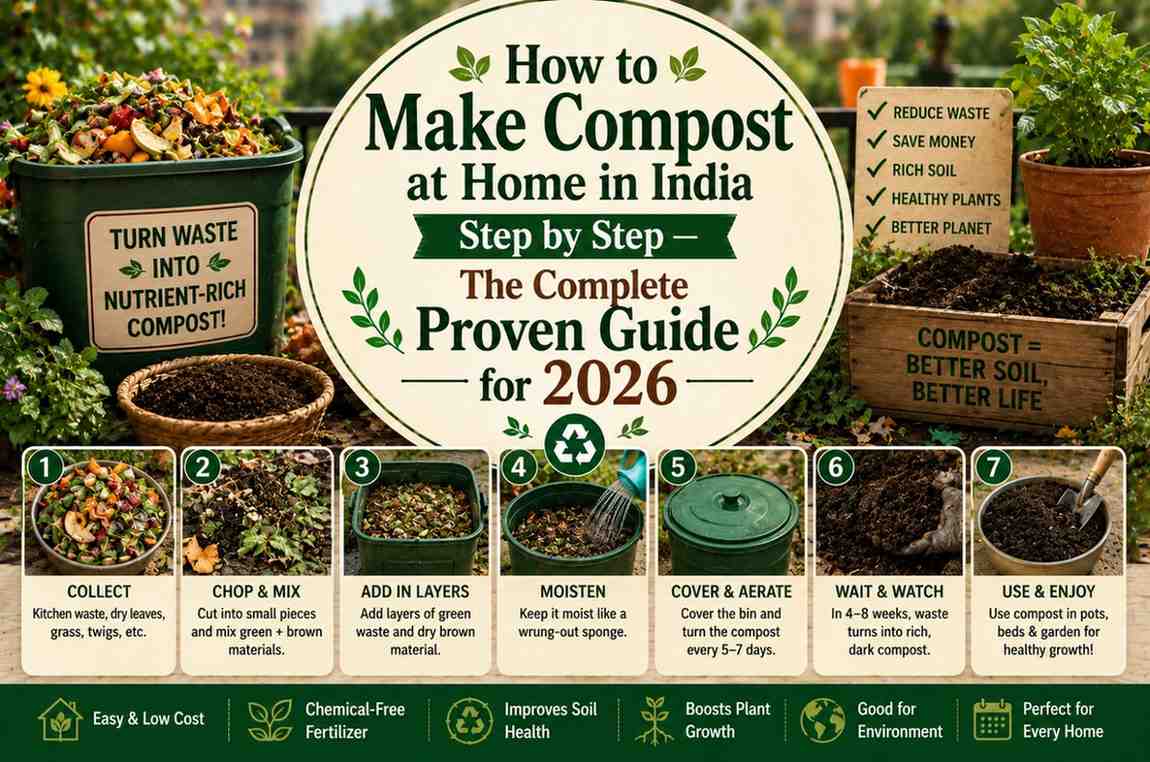
Every day, the average Indian household throws away 300–400 grams of kitchen waste—vegetable peels, fruit scraps, leftover rice, tea grounds, and eggshells. Most of it ends up in a landfill, creating methane gas and adding to pollution.
But here’s the truth: that “waste” is actually liquid gold for your garden. Learning how to make compost at home in India, step by step, is one of the smartest, most eco-friendly, and most rewarding skills you can develop in 2026.
Compost transforms rotting kitchen scraps into a dark, crumbly, nutrient-rich material that plants absolutely love. It improves soil structure, feeds billions of beneficial microorganisms, and completely eliminates the need for chemical fertilizers. Best of all—it costs nothing.
What Is Compost and Why Does Your Garden Need It?
Compost is decomposed organic matter. When food scraps and plant material break down through the action of bacteria, fungi, and other microorganisms, they transform into a substance called “humus”—the foundation of healthy, fertile soil.
Here’s what good compost does for your garden:
- Feeds soil life—compost contains billions of beneficial bacteria and fungi per gram
- Improves soil structure—makes clay soil drain better and sandy soil retain more moisture
- Provides slow-release nutrition — NPK + micronutrients released steadily over months
- Suppresses disease — beneficial microbes outcompete harmful pathogens
- Reduces water usage — compost-rich soil retains moisture 3x better than ordinary soil
Understanding how to make compost at home in India, step by step, is the single most impactful skill for any home gardener.
The Science Behind Composting (Explained Simply)
Composting is nature’s recycling. Microorganisms—bacteria, fungi, and actinomycetes—eat organic material and break it down into simpler compounds.
The process needs four things:
1. Carbon (Browns) Carbon-rich “brown” materials provide energy for microorganisms. Examples: dry leaves, cardboard, newspaper, dried straw, paper bags, sawdust
2. Nitrogen (Greens): Nitrogen-rich “green” materials provide protein for microorganism growth. Examples: vegetable peels, fruit scraps, tea leaves, coffee grounds, fresh grass, cow dung
3. Moisture The compost pile should feel like a wrung-out sponge—moist but not dripping.
4. Oxygen aerobic (oxygen-loving) bacteria do the best decomposition work. Regular turning provides fresh oxygen.
The Golden Ratio: 2–3 parts browns : 1 part greens
This ratio is the heart of how to make compost at home in India step by step. Too many greens = smelly pile. Too many browns = slow decomposition.
What You Can and Cannot Compost
GREEN LIGHT — Add these freely:
Kitchen Greens:
- Vegetable and fruit peels (onion, potato, banana, citrus)
- Leftover cooked vegetables (no oil or masala)
- Tea leaves and tea bags (remove staples)
- Coffee grounds and paper filters
- Eggshells (excellent calcium source)
- Stale roti, bread (in moderation)
- Coconut shells (crushed) and coconut husk
Garden Greens:
- Fresh grass clippings
- Green leaves and plant trimmings
- Flower heads
- Weeds (before they set seed)
Browns to Add:
- Dry leaves (most important brown in India)
- Cardboard torn into small pieces
- Newspaper (black ink only)
- Dried straw or hay
- Dry coconut coir
RED LIGHT — Never compost these:
- Meat, fish, and bones (attract pests and create odour)
- Oily or heavily spiced cooked food
- Dairy products (milk, cheese, curd)
- Diseased plant material
- Pet faeces (dog/cat — human faeces requires hot composting method)
- Plastic, synthetic materials
Method 1: Pot Composting (Best for Apartments)
This is the easiest method for beginners and perfect for learning how to make compost at home in India, step by step, in small urban spaces.
What You Need:
- 2 clay pots or plastic buckets (10–15 litre capacity)
- Drill or nail to make holes in the bottom
- Old newspaper or dry leaves
Step-by-Step Instructions:
Step 1: Prepare the bins. Drill 8–10 small holes in the bottom of each pot for drainage and airflow. Place them on a tray or elevate them slightly.
Step 2: Add a base layer. Place a 2-inch layer of dry leaves, torn newspaper, or dry soil at the bottom of the pot.
Step 3: Add kitchen waste daily. Chop or tear your kitchen scraps into small pieces (smaller = faster decomposition). Add them to the pot.
Step 4: Cover with brown. After every addition of kitchen scraps, add an equal layer of dry leaves or torn cardboard. This is crucial—it controls odor and maintains the carbon-nitrogen balance.
Step 5: Maintain moisture. Sprinkle a little water if the pile seems dry. It should feel damp, not wet.
Step 6: Turn regularly Every 3–4 days, mix the contents with a stick or small trowel. This adds oxygen and speeds decomposition.
Step 7: Switch pots When the first pot is full, stop adding to it and start filling the second pot. Let the first pot rest and mature.
Step 8: Harvest the compost. In 30–45 days, the first pot’s contents should have reduced by 50–60% in volume and turned dark brown and crumbly. It should smell earthy (like a forest floor)—not rotten.
Your compost is ready! Sift it through a mesh and use the fine compost on your plants.
Method 2: Pit Composting (Best for Houses with Gardens)
If you have a backyard or terrace space, pit composting is simple and highly effective.
Steps:
- Dig a pit: 3 feet wide × 3 feet long × 2 feet deep
- Layer 4 inches of browns at the bottom
- Add kitchen and garden waste in 4-inch layers
- Alternate with browns after each layer
- Cover the pit with a jute sack or tarpaulin to retain moisture
- Turn the pile every 7–10 days
- Water if dry
- Ready in 45–60 days
Method 3: Aerobic Compost Bins (Fastest Method)
Commercial compost bins with turning handles or rotating drum composters are available in India for ₹800–₹3,000. These speed up the process to just 14–21 days through better aeration.
Many municipalities in cities like Pune, Bengaluru, and Hyderabad also provide subsidized compost bins to residents—check with your local corporation.
Troubleshooting Your Compost
| Problem | Cause | Solution |
|---|---|---|
| Foul smell | Too many greens, too wet | Add more browns, turn the pile. |
| No decomposition | Too dry, or too many browns | Add water, add kitchen scraps |
| Pests/insects | Food scraps uncovered | Always cover greens with browns; avoid meat/dairy |
| The pile is too hot | Good sign! (55–65°C is ideal.) | Turn more frequently |
| The pile is not heating | Too small or too dry | Make pile larger; add water |
How to Know Your Compost Is Ready
Your compost is mature and ready to use when:
- It is dark brown to black in colour
- It crumbles easily in your hand
- It smells like rich forest soil (earthy and pleasant)
- You cannot identify the original materials
- The pile has reduced to about half its original volume
Do NOT use immature compost—it can burn plant roots and deplete soil nitrogen.
How to Use Finished Compost in Your Garden
Once you understand how to make compost at home in India step by step, you need to know how to apply it correctly:
For potted plants: Mix 20–30% compost into your potting mix. Top-dress every 6–8 weeks with 1–2 inches of compost.
For raised beds: Add 3–4 inches of compost to the bed and dig it in before planting.
For established trees/shrubs: Apply 2–3 inches around the base as mulch/top dressing.
As liquid fertilizer: Soak 1 cup of compost in 5 liters of water for 24 hours. Use the “compost tea” to water plants—an instant, gentle nutrient boost.
IMAGE SUGGESTION 1:
Placement: After Method 1 (Pot Composting) steps. Description: Two clay pots with kitchen scraps and dry leaves layered, on an Indian apartment balcony ALT Text: “how to make compost at home India step by step — pot composting with kitchen waste”
IMAGE SUGGESTION 2:
Placement: After the “How to Know Your Compost Is Ready” section Description: Hands holding dark, crumbly finished compost with a kitchen garden in the background. ALT Text: “how to make compost at home India step by step—dark finished compost ready for garden”
Authority External Resources
- National Centre of Organic and Natural Farming — Composting Guide — Official Indian government composting and organic waste management guidelines.
- ICAR Compost Making Manual — Research-backed technical guides on composting methods for Indian conditions.
- Cornell Composting Science — World-leading university resource on composting science and practice.
- EPA — Composting at Home — US Environmental Protection Agency’s clear and authoritative beginner’s guide.
- Down to Earth — India’s Environment Magazine — India-focused environmental reporting, including composting and organic farming.
FAQs: How to Make Compost at Home India Step by Step
Q1. How long does composting take in India? With the pot method and regular turning, you can have finished compost in 30–45 days. In India’s warm climate (especially in summer), decomposition happens faster than in colder countries. Pit composting takes 45–60 days. Vermicomposting takes just 21–30 days.
Q2. My compost smells bad — what am I doing wrong? A smelly compost pile usually means too many green (nitrogen-rich) materials and not enough brown (carbon-rich) materials. Add dry leaves, torn newspaper, or cardboard immediately. Turn the pile to add oxygen. The smell should disappear within 1–2 days.
Q3. Can I compost in a flat/apartment with no outdoor space? Yes! Use a 10-liter pot or bucket on your balcony. Keep it covered. Add kitchen scraps daily and always top with dry leaves or newspaper. Properly maintained pot composting produces no bad odor and is completely manageable in a flat.
Q4. Can I add cooked food to compost? Plain cooked food without oil or strong spices can be composted in small amounts. However, avoid oily, spicy, or masala-heavy cooked food, as it attracts pests and slows decomposition. Raw kitchen waste works far better.
Q5. Is compost the same as vermicompost? No. Compost is made through bacterial decomposition. Vermicompost is made through earthworm decomposition and is generally richer in immediately plant-available nutrients. Both are excellent organic fertilizers. Many gardeners use both together for maximum benefit.
Conclusion
Learning how to make compost at home in India, step by step, is one of the most impactful things you can do for your garden, your kitchen waste, and the planet.
You reduce landfill waste. You eliminate the need for expensive fertilizers. You build living, thriving soil that grows healthier plants year after year.
Start with a single pot, your daily vegetable peels, and a handful of dry leaves. In 30 days, you will have rich, black compost that your plants will absolutely thrive in.
Begin today — your kitchen waste is already waiting to become something extraordinary.