 editer@organickheti.in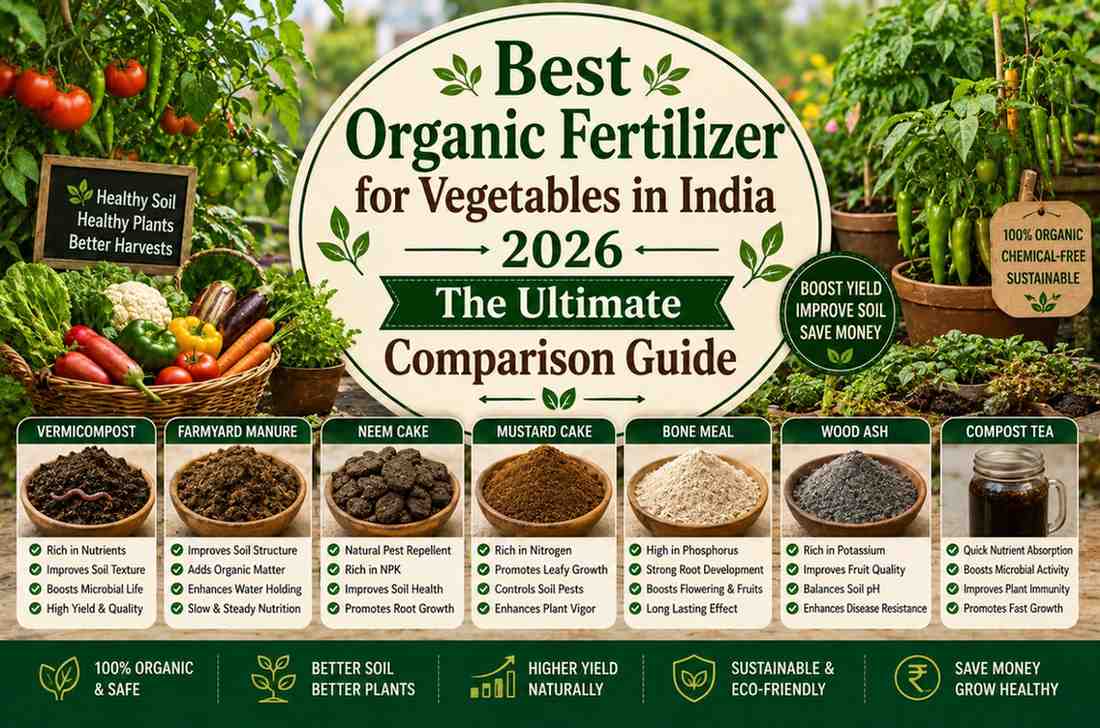
Ask any experienced gardener what single change made the biggest difference to their vegetable garden, and the answer is almost always the same: switching from chemical fertilizers to organic ones.
Choosing the best organic fertilizer for vegetables in India in 2026 is not complicated—but you do need to understand what each fertilizer does, when to use it, and how to apply it correctly. The wrong fertilizer at the wrong time can harm your plants just as much as too little fertilizer.
This complete guide compares India’s top organic fertilizers head-to-head so you can make the smartest choice for your garden, your climate, and your budget.
Why Organic Fertilizers Beat Chemical Fertilizers Every Time
Before comparing the best organic fertilizer for vegetables in India in 2026, let’s understand why organic is always the superior long-term choice.
Chemical fertilizers:
- Provide an instant nutrient spike but nothing beyond NPK
- Kill beneficial soil microorganisms over time
- Leach into groundwater and cause pollution
- Create soil dependency — plants need more every season
- Leave toxic salt buildup that damages soil structure
Organic fertilizers:
- Feed both the plant AND the soil ecosystem
- Build long-term soil fertility season after season
- Improve soil structure, drainage, and water retention
- Safe for earthworms, pollinators, and beneficial insects
- Zero risk of burning plants when used correctly
- Cost nothing (if made at home) or very little
The choice is clear. Now let’s find the best organic fertilizer for vegetables in India in 2026 for your specific needs.
The Top 5 Organic Fertilizers for Vegetables in India
1. Compost — The All-Rounder Champion
What it is: Decomposed kitchen and garden waste transformed by microbial activity into dark, crumbly humus.
Nutrient profile:
- Nitrogen (N): 1–2%
- Phosphorus (P): 0.5–1%
- Potassium (K): 0.5–1%
- Plus: trace minerals, humic acid, beneficial microbes
Best used for: All vegetables as a base soil amendment. Excellent for leafy greens, tomatoes, chilies, and cucumbers.
How to use:
- Mix 20–30% compost into potting soil before planting
- Top-dress 1–2 inches around plants every 6–8 weeks
- Apply as liquid compost tea (1 cup compost soaked in L water for 24 hours)
Pros:
- Free to make from kitchen waste
- Improves soil structure dramatically
- Safe to use in large quantities
- Feeds soil life and improves drainage
Cons:
- Slow-release (not suitable for quick deficiency correction)
- Requires 30–45 days to make
- Lower nutrient density than vermicompost
Cost: Free (DIY) or ₹15–30/kg (purchased) Availability: Everywhere in India Rating for vegetables: 9/10
2. Vermicompost — The Gold Standard
Vermicompost consistently ranks as the best organic fertilizer for vegetables in India 2026 in independent studies and among experienced home gardeners.
What it is: Compost produced through the digestive action of earthworms (usually Eisenia fetida or Lumbricus rubellus).
Nutrient profile:
- Nitrogen (N): 2–3%
- Phosphorus (P): 1.5–2%
- Potassium (K): 1.5–2%
- Plus: plant growth hormones (auxins, cytokinins), humic acid, enzymes, beneficial bacteria
What makes it special: Vermicompost contains plant growth hormones produced by earthworms that actively stimulate root growth, flowering, and fruiting—something no chemical fertilizer can replicate.
Best used for: All vegetables—particularly fruiting crops like tomatoes, chilies, brinjal, cucumber, and beans.
How to use:
- Mix 10–20% vermicompost into potting mix
- Apply 100g per pot (10-litre) every month
- Use as a liquid by soaking 1 cup in L water overnight
Pros:
- Highest nutrient density of all organic fertilizers
- Contains plant growth hormones
- Improves soil biology dramatically
- Excellent water-retention properties
- Can be produced at home for free
Cons:
- Requires earthworms and a setup (vermicomposting bin)
- Takes 21–30 days to produce
- Purchased vermicompost quality varies
Cost: Free (DIY) or ₹30–60/kg (purchased) Availability: Widely available online and in nurseries Rating for vegetables: 10/10
3. Cow Dung Manure (Gobar Khaad)—The Traditional Powerhouse
What it is: Well-composted cattle dung — one of the oldest and most widely used organic fertilizers in India.
Nutrient profile:
- Nitrogen (N): 0.5–1.5%
- Phosphorus (P): 0.3–0.8%
- Potassium (K): 0.5–1.5%
- Plus: beneficial bacteria, fibre for soil structure
Critical warning: Always use WELL-COMPOSTED cow dung—fresh cow dung can burn roots and introduce harmful pathogens. Composted dung should be dark, dry, and odorless.
Best used for heavy feeders like tomatoes, pumpkins, cucumbers, and sweet potatoes. Excellent as a base conditioner for new garden beds.
How to use:
- Mix into soil before planting: 10–15% of soil volume
- Apply 1–2 handfuls per pot as monthly top-dressing
- Use in making Jeevamrut (see below)
Pros:
- Most affordable and widely available organic fertilizer in India
- Improves soil texture and water-holding capacity
- Excellent for improving clay soils
- Strong cultural and traditional backing in Indian agriculture
Cons:
- Lower nutrient density than vermicompost
- Fresh cow dung can burn plants (must be composted first)
- Sourcing quality composted dung can be inconsistent in cities
Cost: ₹5–20/kg or free in rural areas Availability: Easily available across India, especially in nurseries Rating for vegetables: 7.5/10
4. Jeevamrut — The Ancient Biological Miracle
What it is: A fermented biofertilizer rooted in Indian Vedic agriculture — specifically advocated by Subhash Palekar’s Zero Budget Natural Farming (ZBNF) system. It is not a nutrient fertilizer—it is a microbial activator that wakes up the soil’s existing biological life.
Ingredients:
- 10 kg fresh cow dung (native desi breed preferred)
- 10 liters of fresh cow urine
- 2 kg jaggery (gur)
- 2 kg besan (gram flour)
- Handful of native soil (from under a large old tree)
- 200 liters of water
How to make:
- Mix all ingredients in a large drum with L water
- Stir well and cover loosely with a cloth
- Stir once daily for 48–72 hours
- Use within 7 days
How to use:
- Dilute 1:10 with water and drench soil fortnightly
- Apply 200ml per plant as a soil drench
- Can also be sprayed on leaves (filtered first)
What makes it unique: Jeevamrut doesn’t just feed plants — it exponentially multiplies soil microorganism populations, creating a living soil ecosystem. Research on ZBNF farms shows yield increases of 30–150% over 3–4 seasons of regular use.
Best used for: All vegetables, especially in depleted or chemically damaged soils.
Pros:
- Massively improves soil biology
- Extremely cheap to make (costs under ₹100 per 200L batch)
- Backed by centuries of Indian agricultural tradition
- Proven results in organic farming across India
- Recognised by Indian government’s ZBNF program
Cons:
- Requires cow dung and cow urine (not easily available in some cities)
- Must be used within 7 days of preparation
- Doesn’t directly supply high nutrient levels (supplementary fertilizer needed)
Cost: Under ₹100 per 200 L batch Rating for vegetables: 9/10 (when used with vermicompost)
5. Neem Cake — The Dual-Purpose Fertilizer
What it is: The solid residue is left after neem oil is extracted from neem seeds. Rich in nitrogen and natural pest-repelling compounds.
Nutrient profile:
- Nitrogen (N): 4–6%
- Phosphorus (P): 1%
- Potassium (K): 1.5%
- Plus: azadirachtin (natural pesticide), limonoids
Best used for: Pre-planting soil amendment, especially in pest-prone soils. Excellent for tomatoes, chilies, and root vegetables.
How to use:
- Mix 100–150g neem cake per 10-litre pot before planting
- Apply every 45 days as a top-dressing (scratch lightly into soil)
Pros:
- Fertilizes AND controls soil pests simultaneously
- Controls root knot nematodes (a major problem in Indian vegetable gardens)
- Relatively high nitrogen content for an organic fertilizer
- Widely and cheaply available across India
Cons:
- Strong smell (temporary)
- Overuse can slow soil bacterial activity
Cost: ₹30–60/kg Rating for vegetables: 8.5/10
Head-to-Head Comparison Table
| Fertilizer | Nutrient Level | Soil Improvement | Cost | Ease of Use | Best For |
|---|---|---|---|---|---|
| Compost | Medium | Excellent | Free/Low | Easy | All plants, soil building |
| Vermicompost | High | Excellent | Low | Easy | All vegetables |
| Cow Dung Manure | Medium | Good | Very Low | Easy | Heavy feeders, bed prep |
| Jeevamrut | Low (microbial) | Excellent | Very Low | Medium | Soil revival, all crops |
| Neem Cake | Medium-High | Good | Low | Easy | Pest-prone soils, tomatoes, |
The Winning Combination for Indian Vegetable Gardens
The best organic fertilizer for vegetables in India in 2026 is not one product—it is a system:
Base Mix (at planting): Compost 30% + Vermicompost 15% + Neem Cake (100g/10L pot)
Monthly Feeding: 100g vermicompost top-dressed per pot OR liquid compost tea
Fortnightly Soil Drench: Diluted Jeevamrut (1:10 ratio)
Seasonal Booster: Cow dung manure as top-dress before the growing season
This system builds living, fertile soil that improves every season — the true goal of organic gardening.
IMAGE SUGGESTION 1:
Placement: After the vermicompost section Description: Side-by-side comparison of compost, vermicompost, cow dung, and neem cake in small pots in an Indian garden ALT. Text: “best organic fertilizer for vegetables India 2026—compost, vermicompost, cow dung, and neem cake comparison”
IMAGE SUGGESTION 2:
Placement: After the comparison table Description: Indian gardener applying vermicompost to a tomato plant in a grow bag on a terrace ALT Text: “best organic fertilizer for vegetables India 2026—applying vermicompost to vegetable plants”
Authority External Resources
- National Centre of Organic and Natural Farming — Official Indian government guide on approved organic fertilizers and biofertilizers.
- ICAR — Soil Health and Fertility — Research data on organic fertilizer effectiveness in Indian soils.
- Zero Budget Natural Farming — Andhra Pradesh Government — State-level ZBNF program with Jeevamrut research and case studies.
- Rodale Institute — Organic Soil Health — World-leading organic farming research institution.
- FAO — Soil Organic Matter — Global resource on soil organic matter and organic fertilizer science.
FAQs: Best Organic Fertilizer for Vegetables India 2026
Q1. Is vermicompost better than compost for vegetables? Yes, for most vegetables, vermicompost outperforms regular compost in terms of nutrient density, plant growth hormones, and microbial diversity. However, regular compost is still excellent and far better than no compost. The best approach is to use both together.
Q2. How often should I apply organic fertilizer to potted vegetables? For potted vegetables, apply vermicompost or compost top-dressing every 4–6 weeks. Water with liquid compost tea or diluted Jeevamrut every 2 weeks. This maintains steady nutrition without over-feeding.
Q3. Can I buy ready-made Jeevamrut in India? Some organic farming cooperatives and ZBNF centers sell Jeevamrut, but it degrades quickly and should ideally be made fresh. It is very simple and cheap to make at home — the recipe requires just 5 ingredients.
Q4. Is cow dung available in cities for gardening? Yes! Many online platforms, nurseries, and garden centers in Indian cities sell composted and dried cow dung manure in bags. Brands like Ugaoo, TrustBasket, and Garden Tarang offer it online, often delivered to your door.
Q5. Can I use organic fertilizers and Jeevamrut together? Absolutely — they work synergistically. Vermicompost and compost provide nutrients, while Jeevamrut activates the soil biology to unlock those nutrients for plant uptake. Using both gives significantly better results than either alone.
Conclusion
Choosing the best organic fertilizer for vegetables in India in 2026 is about building a system, not just picking one product.
Start with vermicompost as your primary fertilizer. Add regular compost to build soil volume. Use Jeevamrut fortnightly to supercharge your soil’s biological activity. Incorporate neem cake before planting for pest protection. And apply cow dung as a seasonal conditioner.
Your vegetables will grow stronger, taste better, and need less water — all without a single chemical input.
Your soil is alive. Feed it organically, and it will feed you back in abundance.