 editer@organickheti.in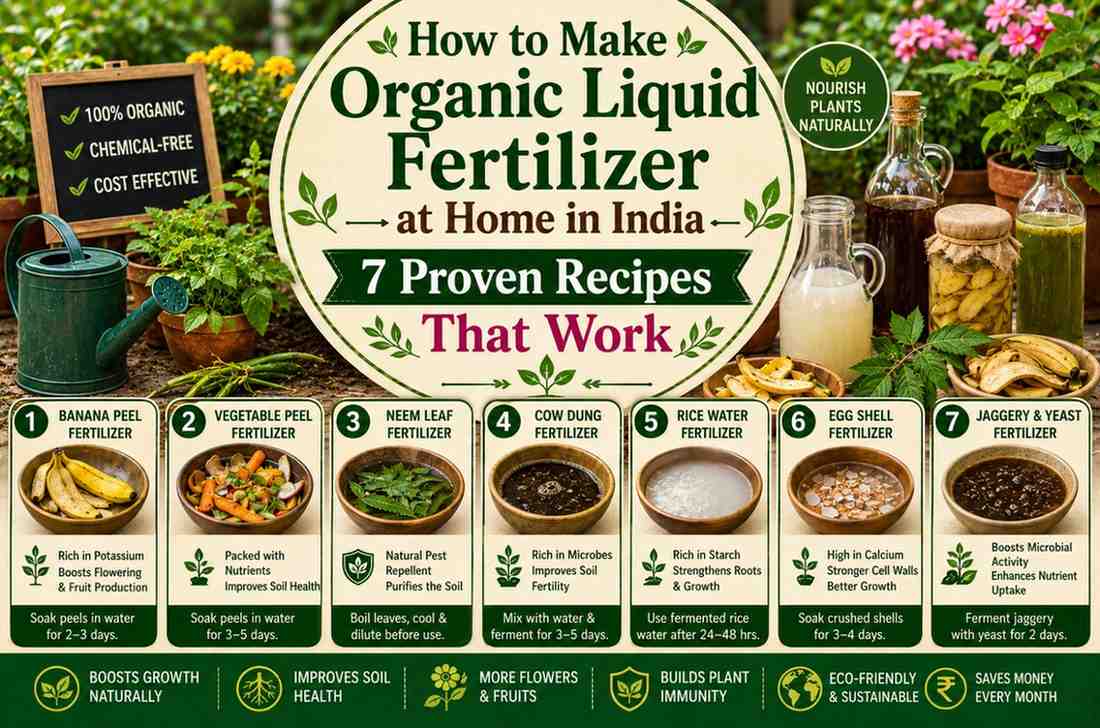
Every day, Indian kitchens generate a treasure chest of plant nutrition — and throw it all in the bin.
Banana peels, onion skins, rice water, buttermilk, eggshells, and vegetable peelings are not waste. They are free, powerful fertilizers that your garden is desperately missing.
Learning how to make organic liquid fertilizer at home in India is one of the most practical, money-saving, and impactful skills any home gardener can develop. These liquid fertilizers are fast-acting (faster than solid compost), easy to make, and completely free from your existing kitchen waste.
This guide gives you 7 detailed, tried-and-tested recipes you can start making today.
Why Liquid Fertilizers Are Superior for Home Gardens
Before diving into how to make organic liquid fertilizer at home in India, let’s understand why liquids are so effective:
Faster absorption — Nutrients in liquid form are immediately available for plant uptake through roots and leaves. Solid fertilizers take weeks to break down.
Foliar feeding is possible—You can spray diluted liquid fertilizers directly on leaves (foliar feeding), which is 10x faster than soil application for quick deficiency correction.
Precise application — Easy to control exactly how much nutrition each plant receives.
Zero cost—made from kitchen waste that you were going to throw away anyway.
Gentle and safe — When properly diluted, liquid organic fertilizers will not burn plant roots, unlike concentrated chemical fertilizers.
Golden Rule: Always Dilute Before Using
This is the most important instruction for every recipe in this guide.
Undiluted liquid fertilizers can be too concentrated and may harm plant roots. Always dilute unless the recipe specifically says to use it undiluted.
General dilution guide:
- Fermented liquids: dilute 1:10 to 1:20 (1 part liquid to 10–20 parts water)
- Soaked liquids: dilute 1:5 to 1:10
- Fresh infusions (rice water, vegetable wash water): use directly without dilution
When in doubt, dilute more. A weaker dose applied more frequently is always safer than a concentrated dose.
Recipe 1: Banana Peel Fertilizer — Liquid Potassium Boost
Banana peels are exceptionally rich in potassium (K), which promotes flowering, fruiting, disease resistance, and strong root systems. They also contain calcium, magnesium, and phosphorus.
This is one of the most popular recipes for how to make organic liquid fertilizer at home in India—because every Indian kitchen uses bananas!
Method A: Banana Peel Soak (Quick)
- Collect 3–4 banana peels
- Chop into small pieces
- Soak in 1 litre of water for 24–48 hours
- Strain and dilute 1:5 with water
- Water plants with this liquid
Method B: Fermented Banana Peel (More Powerful)
- Fill a jar with chopped banana peels
- Cover completely with water
- Add 1 tsp jaggery (speeds fermentation)
- Cover with cloth and let ferment for 5–7 days
- Strain, dilute 1:10, and water plants
Best for: tomatoes, chilies, brinjal, cucumbers, flowering plants—any plant in the fruiting/flowering stage.
Apply: Every 2 weeks during the flowering and fruiting stages.
Recipe 2: Rice Water Fertilizer — Gentle All-Purpose Feed
Rice water is the starchy water left after washing or boiling rice. It is gentle, mild, and packed with:
- Starch (feeds beneficial soil bacteria)
- B vitamins
- Small amounts of nitrogen, phosphorus, and potassium
This is the easiest recipe in this how-to-make-organic-liquid-fertilizer-at-home-in-India guide—you’re making it already!
Method A: Rice Wash Water (Simplest) Save the first wash water from rinsing rice. Use it directly on plants (no dilution needed). Apply every 2–3 days.
Method B: Fermented Rice Water (More Potent)
- Soak 1 cup rice in 3 cups water for 24–48 hours
- The water will become cloudy and slightly sour-smelling
- Dilute 1:5 with fresh water
- Water plants
Fermented rice water contains lactic acid bacteria (LAB) that improve soil health and suppress disease.
Best for: All plants, especially seedlings and leafy vegetables.
Apply: Every 3–5 days.
Recipe 3: Onion Skin Fertilizer — Antifungal + Potassium Boost
Onion skins are typically thrown away, but they are rich in:
- Potassium (strengthens plant cell walls)
- Quercetin (antifungal compound)
- Sulfur (improves protein synthesis in plants)
Recipe:
- Collect dry outer skins from 5–6 onions
- Boil in 1 litre of water for 10 minutes OR soak in cold water for 48 hours
- Let cool, strain
- Dilute 1:5 with fresh water
- Water plants or spray on leaves
Best for: All vegetables — especially effective against fungal problems when sprayed on leaves.
Apply: Every 10–14 days, or spray on leaves when fungal issues appear.
This is a key recipe for how to make organic liquid fertilizer at home in India that doubles as a natural fungicide.
Recipe 4: Eggshell Calcium Fertilizer — Prevents Blossom End Rot
Calcium deficiency in tomatoes and peppers causes the devastating problem called blossom end rot—the black, sunken bottom on fruit that ruins harvests.
Eggshells are 95% calcium carbonate — exactly what calcium-deficient plants need.
Recipe:
- Collect 10–12 eggshells
- Rinse and dry completely
- Crush into fine powder (grinder or rolling pin)
- Soak crushed shells in 1 litre of water with 1 tbsp apple cider vinegar for 48 hours
- The vinegar dissolves the calcium into the water
- Strain, dilute 1:5 with water, and apply
Alternatively: Boil crushed eggshells in 2 liters of water for 15 minutes. Cool, strain, and use directly.
Best for: tomatoes, capsicum, cucumbers, brinjal—any fruiting vegetable prone to blossom end rot.
Apply monthly as a preventive drench or fortnightly if deficiency symptoms appear.
Recipe 5: Vegetable Peel Fermented Fertilizer (Peel Tea)
All those vegetable peelings—potato, carrot, bottle gourd, bitter gourd, and taro—are nitrogen, phosphorus, and potassium rich.
Recipe:
- Collect 1 week of vegetable peelings (avoid oily/spiced cooked scraps)
- Blend with enough water to make a slurry
- Add 1 tsp jaggery to kick-start fermentation
- Cover loosely and leave for 5–7 days, stirring daily
- Strain well through a cloth
- Dilute 1:15 with water and apply as a soil drench
This is a broad-spectrum all-purpose fertilizer with a good balance of NPK.
Best for: All vegetables.
Apply: Every 2 weeks.
Recipe 6: Buttermilk (Chaas) Fertilizer — Microbial Boost + Calcium
Buttermilk is a byproduct of making butter and is widely available in Indian homes. Thin chaas (buttermilk) contains the following:
- Lactic acid bacteria (LAB) that improve soil biology
- Calcium
- Proteins and amino acids
Recipe:
- Mix 1 part thin buttermilk with 9 parts water
- Apply directly as a soil drench
- Can also be sprayed on leaves for fungal disease control (particularly powdery mildew)
Best for: All vegetables. Particularly excellent for reviving plants in depleted or chemically damaged soil.
Apply: Every 2 weeks as a soil drench.
Recipe 7: Wood Ash Liquid — Instant Potassium + pH Correction
Wood ash (from burning wood, not coal) contains up to 7% potassium oxide and 20% calcium, plus magnesium and trace minerals.
Recipe:
- Mix 2 tablespoons of dry wood ash into 1 liter of water
- Stir well and let sit for 24 hours
- Decant the clear liquid carefully (leave the ash settled at the bottom)
- Use the liquid directly — no further dilution needed
Best for: Potassium-hungry fruiting crops (tomatoes, cucumbers, beans). Also helps neutralize slightly acidic soils.
Caution: Do not use on acid-loving plants like blueberries. Do not overuse it—once every 3–4 weeks maximum.
Comparison Table: Which Liquid Fertilizer for Which Need?
| Fertilizer | Key Nutrients | Best For | Frequency |
|---|---|---|---|
| Banana Peel | Potassium, Calcium | Flowering, fruiting stage | Every 2 weeks |
| Rice Water | Starch, B vitamins | Seedlings, leafy greens | Every 3–5 days |
| Onion Skin | Potassium, Quercetin | All plants, antifungal | Every 10–14 days |
| Eggshell | Calcium | Tomatoes, capsicum, | Monthly |
| Vegetable Peel | NPK-balanced | All vegetables | Every 2 weeks |
| Buttermilk | LAB bacteria, Calcium | Soil revival | Every 2 weeks |
| Wood Ash | Potassium, Calcium | Fruiting crops | Every 3–4 weeks |
How to Store Homemade Liquid Fertilizers
Proper storage is essential when learning how to make organic liquid fertilizer at home in India:
- Fermented fertilizers — Store in airtight or loosely covered containers. Use within 2 weeks.
- Fresh infusions (rice water, banana soak) — Use within 3–5 days. Keep in the shade.
- Boiled/cooked preparations — Cool completely before storing. Use within 1 week. Refrigerate if possible.
- Always label containers with the recipe name and date made.
- Fermented liquids smell strong — this is normal and a sign of microbial activity!
Signs Your Plants Are Thriving on Liquid Fertilizers
Within 1–2 weeks of regular liquid fertilizer application, you should see:
- Deeper, darker green leaf colour (nitrogen response)
- New growth appearing at shoot tips (overall vigour)
- More flower buds forming (potassium response)
- Improved leaf glossiness (general health)
- Reduced pest damage (stronger, healthier plants resist pests better)
IMAGE SUGGESTION 1:
Placement: After Recipe 1 (Banana Peel) Description: Chopped banana peels soaking in a jar of water on an Indian kitchen counter, with a spray bottle beside it. ALT Text: “how to make organic liquid fertilizer at home India — banana peel fertilizer soaking in jar”
IMAGE SUGGESTION 2:
Placement: After the comparison table Description: Several labelled jars of different homemade liquid fertilizers (banana peel, onion skin, rice water) arranged on a shelf ALT Text: “how to make organic liquid fertilizer at home India—collection of homemade liquid fertilizers”
Authority External Resources
- National Centre of Organic and Natural Farming India — Official guidance on approved organic inputs for Indian conditions.
- ICAR — Biofertilizers and Liquid Organic Fertilizers — Research on biofertilizer effectiveness in Indian soils.
- Rodale Institute — Organic Nutrition — Science-backed organic fertilizer research.
- AMS—USDA Organic Regulations—International standards for approved organic inputs.
- Krishi Jagran — Liquid Biofertilizers — India-specific guidance on liquid organic fertilizers.
FAQs: How to Make Organic Liquid Fertilizer at Home India
Q1. How do I know if my homemade liquid fertilizer has gone bad? A healthy fermented fertilizer has a sour, earthy, or yeasty smell — not pleasant, but not aggressively foul. If it smells of decay (rotten eggs/hydrogen sulfide) or shows green or black mold on the surface (not just foam), discard and start fresh. Most properly made liquid fertilizers are fine for 1–2 weeks.
Q2. Can I mix different liquid fertilizers together? Yes! You can combine banana peel water, rice water, and onion skin tea together for a balanced all-purpose liquid fertilizer. Just make sure each component is properly diluted before mixing. Avoid mixing buttermilk-based fertilizers with other fermented liquids.
Q3. Is homemade liquid fertilizer as effective as commercial organic fertilizers? Individual homemade liquid fertilizers are lower in nutrient concentration than commercial organic fertilizers like concentrated seaweed extract or fish emulsion. However, used consistently and combined with solid organic amendments (compost and vermicompost), they are more than sufficient for a productive home vegetable garden.
Q4. Can I use these liquid fertilizers on seedlings? Yes, but always use maximum dilution for seedlings (1:20 or more). Seedlings are sensitive. Rice water is the gentlest and most seedling-friendly. Avoid strong fermented liquids on seedlings less than 2 weeks old.
Q5. How much liquid fertilizer should I apply per pot? A general guideline: apply enough liquid to thoroughly wet the soil to root depth. For a standard 12-liter pot, this is approximately 500 ml–1 liter of diluted liquid fertilizer per application. For foliar spraying, spray until liquid just begins to drip off the leaves.
Conclusion
Now you know how to make organic liquid fertilizer at home in India using ingredients you already have in your kitchen—for free.
From banana peels that supercharge flowering to rice water that feeds billions of soil bacteria, these seven recipes give your plants immediate, safe, chemical-free nutrition derived entirely from kitchen waste.
Start with rice water and banana peel tea—the two easiest and most impactful. Expand your liquid fertilizer toolkit as you gain confidence.
Every banana peel you save is free fertilizer. Every jar of rice water you repurpose is a gift to your garden. Start saving, start brewing, and watch your plants transform.