
 editer@organickheti.in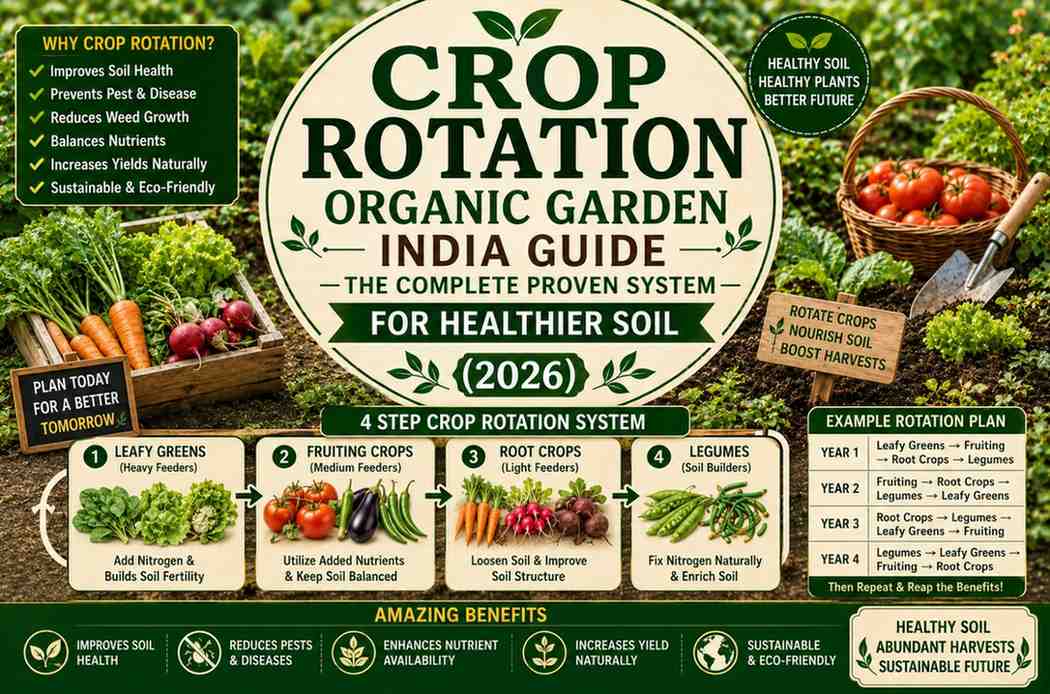
Ask the most successful organic farmers in India how they maintain productive, disease-free plots season after season without chemicals — and virtually all of them will mention the same ancient practice: crop rotation.
This crop rotation organic garden India guide explains one of the most powerful, scientifically validated, and completely free techniques in organic gardening. It costs nothing to implement. It requires no purchases, no spraying, no chemicals. And it has been used by Indian farmers for thousands of years.
Yet most home gardeners ignore it — and pay the price in depleted soil, recurring pests, and declining yields.
What Is Crop Rotation?
Crop rotation is the practice of growing different types of vegetables in different positions each season, rather than planting the same crop in the same spot repeatedly.
For example: if you grew tomatoes in a particular bed last winter, you plant beans or leafy greens there next season — and move the tomatoes to a different bed.
The underlying principle is beautifully simple: different plants affect the soil differently. By rotating plant families, you prevent the buildup of specific pests and diseases, balance soil nutrients, and maintain a diverse, healthy soil ecosystem.
This crop rotation organic garden India guide will show you exactly how to implement this system — even in a small balcony or terrace garden.
Why Crop Rotation Is Essential for Organic Gardens
In a chemical garden, pesticides and synthetic fertilizers can mask the problems caused by growing the same crop repeatedly. In an organic garden, those compensating chemicals don’t exist — so soil health becomes critical.
Here’s what happens when you DON’T rotate crops:
Pest and pathogen buildup: Pests and soil-borne diseases specific to a crop family (like tomato blight, clubroot in brassicas, or root knot nematodes in chillies) build up in the soil over seasons. Each year, the problem gets worse.
Nutrient depletion: Every plant family draws different nutrients from the soil. Planting the same family repeatedly strips specific nutrients (heavy feeders like tomatoes rapidly exhaust nitrogen and calcium from the same spot).
Allelopathy: Some plants release chemicals that inhibit their own regrowth (tomatoes and fennel are classic examples). Planting in the same spot suppresses germination and growth.
Weakened soil biology: Monoculture (same crop in same spot) reduces microbial diversity, weakening the soil ecosystem.
This crop rotation organic garden India guide shows you how to avoid all of these problems with a simple, seasonal planting plan.
Understanding Plant Families — The Foundation of Crop Rotation
The key to effective crop rotation is grouping plants by botanical family. Plants in the same family share similar nutrient needs, pests, and diseases — so they should always rotate together.
The 6 Main Plant Families for Indian Vegetable Gardens:
1. Solanaceae (Nightshade Family) Plants: Tomatoes, chillies, capsicum, brinjal (baingan), potatoes Nutrient needs: Heavy nitrogen and calcium feeders Common pests/diseases: Early blight, late blight, root knot nematodes, whiteflies
2. Cucurbitaceae (Gourd Family) Plants: Cucumber, pumpkin, lauki (bottle gourd), karela (bitter gourd), tinda, turai Nutrient needs: Heavy feeders, especially potassium Common pests/diseases: Powdery mildew, mosaic virus, cucumber beetles
3. Fabaceae (Legume Family) Plants: Beans (sem), peas (matar), lobia (black-eyed peas), chana, moong Special property: NITROGEN FIXERS — add nitrogen to soil Common pests/diseases: Aphids, bean mosaic virus
4. Brassicaceae (Mustard/Cabbage Family) Plants: Cabbage, cauliflower, broccoli, radish, sarson (mustard greens) Nutrient needs: Heavy nitrogen feeders Common pests/diseases: Clubroot, cabbage white butterfly, diamondback moth
5. Apiaceae (Carrot Family) Plants: Carrot, coriander (dhania), fennel, parsley Nutrient needs: Moderate, especially phosphorus Common pests/diseases: Carrot fly, aphids
6. Amaryllidaceae / Alliaceae (Onion Family) Plants: Onion, garlic, leek, chives Special property: Natural pest repellents — good companions for many crops Common pests/diseases: Onion thrips, white rot
The 4-Bed Crop Rotation System
The classic crop rotation system uses 4 growing areas (beds, groups of pots, or sections of a terrace) and rotates plant families through them over 4 seasons.
In India’s gardening calendar (with Rabi, Kharif, and spring transitions), this can be adapted to a 2–4 season rotation depending on your growing region.
The Standard 4-Group Rotation:
Group A — Heavy Feeders (Solanaceae + Cucurbitaceae) Tomatoes, chillies, brinjal, cucumbers, pumpkins
Group B — Legumes (Nitrogen Fixers) Beans, peas, lobia, moong
Group C — Brassicas + Root Vegetables Cabbage, cauliflower, radish, carrot, beetroot
Group D — Leafy Greens + Alliums + Herbs Spinach, methi, coriander, onion, garlic, mint
Rotation Pattern:
| Season | Bed 1 | Bed 2 | Bed 3 | Bed 4 |
|---|---|---|---|---|
| Season 1 | Group A | Group B | Group C | Group D |
| Season 2 | Group B | Group C | Group D | Group A |
| Season 3 | Group C | Group D | Group A | Group B |
| Season 4 | Group D | Group A | Group B | Group C |
Each group moves one position forward each season. After 4 seasons, each bed has hosted all 4 plant groups — and the rotation begins again.
Why Legumes Are the Superstar of Crop Rotation
Understanding why legumes are so valuable is central to this crop rotation organic garden India guide.
Legumes (beans, peas, lobia, moong) have a unique relationship with soil bacteria called Rhizobium. These bacteria live in nodules on legume roots and convert atmospheric nitrogen (N₂ from air) into ammonium (NH₄⁺) — a form plants can absorb.
This means legumes add nitrogen to the soil as they grow. When legumes are removed at season’s end and their roots left in the soil to decompose, they release this stored nitrogen — feeding the next crop.
In your rotation plan, always follow heavy feeders (tomatoes, cucumbers) with legumes. The legumes will restore the nitrogen that the heavy feeders consumed.
This is free fertilization — powered entirely by soil biology.
Crop Rotation for Small Balcony and Container Gardens
“But I only have 6 pots on my balcony!” is a common response when people first encounter crop rotation advice. The good news: crop rotation absolutely works for container gardens — with some adaptations.
Pot Rotation Strategy:
Simple approach: Each pot hosts a different plant family every season. Keep a basic notebook (or phone note) of what you grew in each pot each season.
Practical example (6-pot balcony):
| Pot | Season 1 (Winter) | Season 2 (Summer-Monsoon) |
|---|---|---|
| Pot 1 | Tomatoes (Solanaceae) | Beans (Legume) |
| Pot 2 | Chillies (Solanaceae) | Cucumber (Cucurbit) |
| Pot 3 | Spinach (Leafy) | Bhindi (can be considered neutral — rotate to chilli next) |
| Pot 4 | Beans (Legume) | Brinjal (Solanaceae) |
| Pot 5 | Coriander + methi (Herbs/Leafy) | Radish (Brassicaceae) |
| Pot 6 | Radish (Brassicaceae) | Tomatoes (Solanaceae) |
The key is: never grow the same plant family in the same pot two seasons in a row.
Additional Pot Rotation Tip:
After each crop, refresh pot soil by removing the top 3–4 inches and replacing with fresh compost or vermicompost mixed with cocopeat. This partially compensates for the reduced rotation depth possible in containers.
Indian Seasonal Crop Rotation Calendar
| Season | Months | Suggested Rotation |
|---|---|---|
| Rabi (Winter) | Oct–Feb | Tomatoes/Chillies → Beans → Radish/Carrot → Spinach/Methi |
| Summer Transition | Feb–April | Beans → Bhindi → Coriander → Chillies |
| Kharif (Monsoon) | June–Sept | Cucumbers/Gourds → Amaranth → Beans → Brinjal |
| Post-Monsoon | Sept–Oct | Legumes → Leafy greens → Root vegetables → Rest/compost |
The “Rest and Restore” Bed Approach
In more advanced crop rotation organic garden India guide practices, experienced organic gardeners include a rest season for each bed once every 3–4 seasons.
During the rest season:
- Don’t plant any vegetable
- Cover the bed with a green manure crop (sunhemp, moong, dhaincha) — these fix nitrogen and their roots break up soil
- After 6–8 weeks, cut the green manure at the base and dig it into the soil
- Apply thick mulch and allow the bed to rest for 4–6 weeks before planting again
This “biological fallow” dramatically restores soil biology and breaks pest and disease cycles.
Companion Planting Within Crop Rotation
Crop rotation and companion planting work beautifully together in an organic garden. Within each rotation group, always include companion plants:
With Solanaceae: Plant marigolds at corners; basil/tulsi between plants With Legumes: Plant onions or garlic at edges (repel aphids) With Brassicas: Plant dill or fennel nearby (attracts beneficial insects) With Leafy Greens: Plant chives or garlic as borders (repel most sucking insects)
Common Mistakes in Crop Rotation
1. Rotating individual plants, not families — Moving tomatoes out and putting brinjal in (still Solanaceae!) provides no rotation benefit. Always think in plant families.
2. Not keeping records — Without written records, you’ll forget what grew where. A simple notebook or app photo is enough.
3. Too small a gap between related crops — A 1-season gap is minimum. A 2–3 season gap is ideal for disease-prone families like Solanaceae.
4. Ignoring alliums as rotation tools — Onions and garlic are powerful natural sanitizers. Including them in rotation helps cleanse soil of many pathogens.
5. Skipping legumes — Farmers who skip legumes in their rotation must add more external nitrogen inputs. Legumes are free nitrogen factories — never skip them.
IMAGE SUGGESTION 1:
Placement: After the 4-bed rotation table Description: Four raised garden beds in an Indian backyard garden with different crops growing in each — tomatoes, beans, leafy greens, and radish ALT Text: “crop rotation organic garden India guide — four bed rotation system with different vegetable families”
IMAGE SUGGESTION 2:
Placement: After the container garden rotation section Description: Labelled pots on an Indian balcony showing a simple crop rotation tracking system with handwritten plant names ALT Text: “crop rotation organic garden India guide — pot rotation system on apartment balcony”
Authority External Resources
- ICAR — Crop Rotation Research India — Indian scientific research on crop rotation effects on soil health and yield.
- National Centre of Organic and Natural Farming — Official Indian government guidance on organic crop management and rotation.
- Rodale Institute — Crop Rotation Guide — World-leading organic research on crop rotation in organic systems.
- FAO — Crop Rotation and Soil Health — International guidance on crop rotation for sustainable agriculture.
- Cornell University — Vegetable Crop Rotation — Science-backed university guide to vegetable crop rotation principles.
FAQs: Crop Rotation Organic Garden India Guide
Q1. How many seasons should I wait before replanting the same crop family in the same spot? For most plant families, a minimum 2-season gap is recommended. For disease-prone families like Solanaceae (tomatoes, chillies, brinjal) and Brassicaceae (cabbage, cauliflower), a 3–4 season gap is ideal. This is long enough for most soil-borne pathogens to die out without a host plant.
Q2. Does crop rotation work in grow bags and pots? Yes, with modifications. Rotate plant families between pots each season. Additionally, refresh the top 3–4 inches of potting soil between crops and add fresh compost. Since pots can’t be fully rested like beds, this soil refresh is an important supplement to pot rotation.
Q3. What should I grow after tomatoes to restore soil health? Tomatoes are heavy nitrogen feeders. After tomatoes, grow legumes (beans, peas, or moong) in the same spot. Legumes will fix nitrogen back into the soil. Follow the legumes with leafy greens (which benefit from the nitrogen boost) in the next season.
Q4. Can I do crop rotation with perennial plants like curry leaves and tulsi? Perennial plants like curry leaves, tulsi, lemongrass, and mint stay in the same container or spot year-round — they don’t participate in seasonal rotation. Focus crop rotation on annual vegetables. Perennials can serve as fixed companion plants in your rotation system.
Q5. Is crop rotation effective enough to completely prevent pest and disease problems? Crop rotation dramatically reduces pest and disease pressure but doesn’t eliminate it entirely. It is most effective when combined with other organic practices: companion planting, neem oil sprays, healthy soil building with compost, and regular plant inspection. Together, these practices create a resilient, largely self-managing organic garden.
Conclusion
This crop rotation organic garden India guide gives you a complete, practical system for one of the most powerful techniques in all of organic gardening.
Crop rotation requires no money. It requires no chemicals. It requires only planning, observation, and a simple seasonal notebook. In return, it gives you improved soil health, dramatically reduced pest and disease pressure, naturally balanced soil nutrients, and consistently higher yields — season after season.
Whether you have 4 raised beds in a Bengaluru backyard or 8 grow bags on a Mumbai balcony, the principles of this crop rotation organic garden India guide apply directly to your space.
Plan your next season now. Draw your beds. Note your plant families. Rotate deliberately — and let nature do the rest. Your soil will become richer with every season, and your organic garden will become more productive and resilient with every rotation.