
 editer@organickheti.in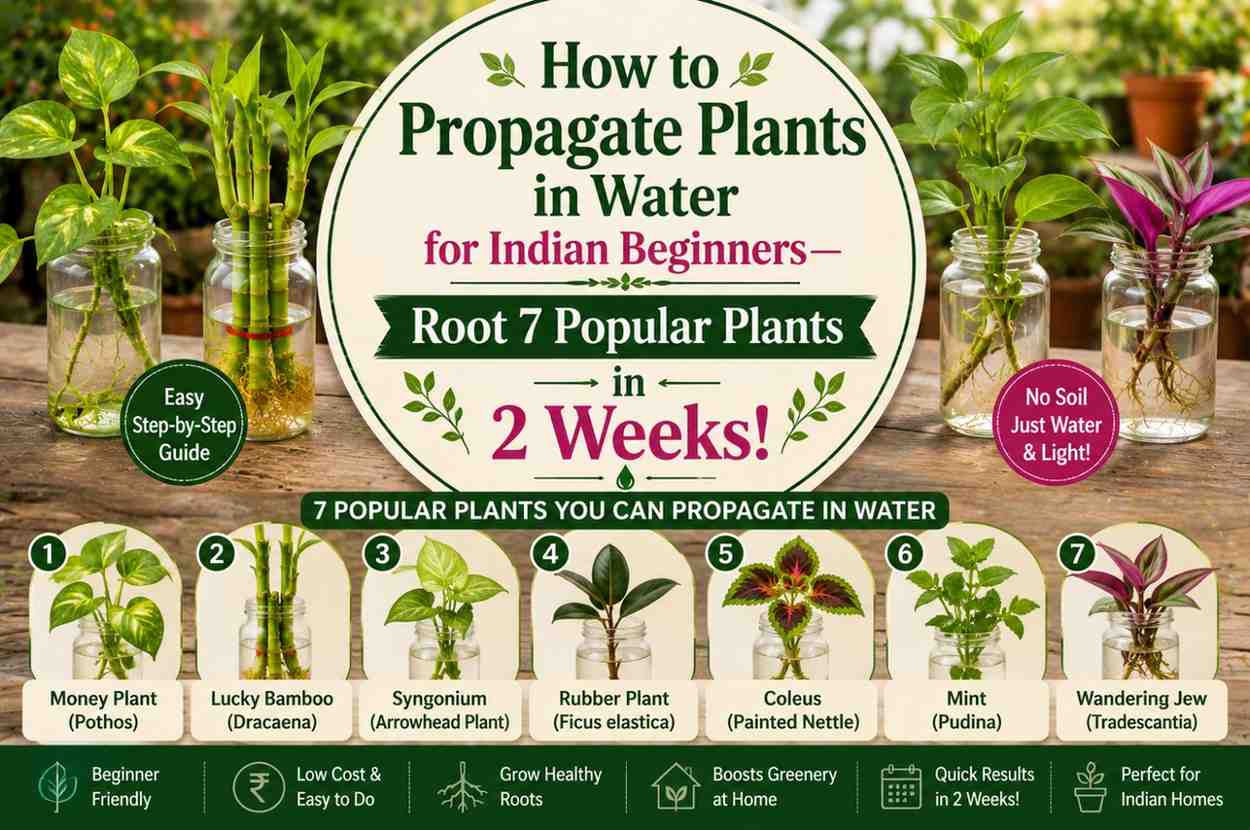
What if you could turn one plant into ten—for free, with no special tools, no soil, and no experience?
That’s exactly what water propagation allows you to do. And learning how to propagate plants in water, India’s beginner’s guide, is one of the most exciting, satisfying, and genuinely easy skills in all of indoor gardening.
You take a cutting from a healthy plant, place it in a jar of water, and set it near a bright window—and within days, you watch tiny white roots emerge from the stem. It feels like magic. It is actually just biology.
In India’s warm climate, water propagation works even faster than in cooler countries. Most popular houseplants root in 1–3 weeks, and you can propagate them all year round—turning a single money plant into an entire room full of lush green life, completely for free.
Why Water Propagation Is Perfect for Indian Beginners
There are several ways to propagate plants (soil cutting, air layering, division, and seed). But how to propagate plants in water: India’s beginner’s guide focuses on water propagation because it is uniquely suited to Indian conditions and beginner gardeners:
- No soil needed — no mess, no supplies to buy
- Visible progress — you can watch roots grow, unlike soil cuttings
- Faster in India’s warmth — heat accelerates root development
- Uses recycled containers—old glass bottles, plastic bottles, steel tumblers all work
- Very forgiving—if something goes wrong, you can see it immediately and fix it
- Free plants—expand your collection and share with friends and neighbours
- Year-round propagation—India’s warm temperatures mean you can propagate most plants throughout the year (best in spring and early monsoon)
What You Need to Get Started
The beauty of how to propagate plants in water: an India beginner’s guide is that you likely already have everything you need.
Equipment (all free or very low cost):
Containers:
- Glass jars (jam jars, pickle jars, coconut oil jars — widely used in Indian households)
- Plastic bottles (cut the top off a used mineral water bottle)
- Steel tumblers (excellent for Indian kitchens)
- Small glass vases
- Recycled glass bottles
Avoid: Opaque containers — you want to see the roots growing. Also avoid very wide-mouthed containers for small cuttings (the stem needs some support).
Water:
- Plain tap water is fine for most plants
- Let tap water sit overnight in an open container before use—this allows chlorine to evaporate (chlorine can slow root development)
- If your city water is very hard (high TDS, above 400 ppm), use filtered water or rainwater when possible
Tools (optional but helpful):
- Clean scissors or pruning blade (washed with soap or wiped with alcohol)
- Rooting hormone powder (available at nurseries for ₹30–80) — optional, but speeds root development
- Small stones or marbles to prop cuttings upright in the jar
The Golden Rules of Water Propagation
Before learning how to propagate plants in water in India, beginners, step by step, follow these non-negotiable rules:
Rule 1: No leaves in the water Any leaf submerged in water will rot. Rotten leaves contaminate the water and kill the cutting. Remove every leaf that will be below the water line.
Rule 2: Change the water regularly. Change water every 5–7 days (more frequently in hot Indian summers). Stale water grows bacteria and algae that suffocate developing roots.
Rule 3: Keep in bright indirect light. Direct harsh sunlight heats the water, grows algae, and stresses cuttings. Bright indirect light (near a window, but not in direct sun) is ideal.
Rule 4: Use clean containers. Dirty containers harbor bacteria. Wash jars with soap and rinse thoroughly before use.
Rule 5: Be patient. Some cuttings root in 5 days. Others take 3–4 weeks. India’s warm climate speeds things up significantly—trust the process.
Step-by-Step: How to Propagate Plants in Water Indian Beginners
Step 1: Choose a Healthy Parent Plant
Always take cuttings from a healthy, vigorous plant. A plant that is stressed, pest-infested, or diseased will produce poor cuttings that rot instead of root.
Look for:
- Firm, green stems (not yellow or wilting)
- No signs of pest damage on leaves or stems
- Active new growth (sign that the plant has good energy)
Step 2: Take the Cut Correctly
This is the most critical step in how to propagate plants in water in India for beginners.
For node cuttings (most common—Pothos, Money Plant, Monstera, Philodendron):
Look for a node—the point where a leaf attaches to the stem. This is where roots will emerge.
- Cut the stem just below a node (5 mm below) using clean scissors
- Your cutting should be 10–15cm long with 2–3 leaves at the top
- Remove all leaves that will be submerged in water
- Leave 1–2 leaves above the water line for photosynthesis
For stem cuttings (hibiscus, mogra, roses):
- Cut a semi-hardwood stem (not too young and green, not too woody and old)
- 15–20cm long, with 2–3 leaf nodes
- Cut at a 45-degree angle (increases surface area for water absorption)
- Remove lower leaves, keep top 1–2 leaves
Step 3: Optional — Apply Rooting Hormone
Dip the cut end of the stem briefly in rooting hormone powder and tap off the excess. This is optional but can speed root development by 30–50% and is especially helpful for slower-rooting plants like roses and hibiscus.
Free natural rooting hormone alternative: Dip the cutting end in fresh aloe vera gel for 60 seconds before placing in water. Aloe vera contains auxins — natural plant hormones that stimulate root growth. Widely available across India.
Step 4: Place in Water
Fill your clean jar with room-temperature water (de-chlorinated if possible).
Place the cutting so the node is fully submerged but the leaves are above the water. Use small stones, marbles, or crumpled newspaper to prop the cutting upright if needed.
Position the jar in bright indirect light—near a north or east-facing window in India is ideal.
Step 5: Maintain the Water
- Change water every 5–7 days — pour out the old water and refill with fresh, room-temperature water
- In Indian summer (above 35°C), change water every 3–4 days
- If algae (green coating) develops inside the jar, clean the jar immediately
- Keep the jar away from air conditioner vents (cold, dry air stresses cuttings)
Step 6: Watch the Roots Grow!
In India’s warm temperatures, you should see the following:
- Days 3–7: Small white bumps appear at the node—these are root primordia (the beginning of roots)
- Days 7–14: Tiny white roots emerge from the node
- Days 14–28: Roots grow to 2–5cm long
This is the most exciting part of how to propagate plants in water for Indian beginners—watching roots appear from what was just a cut stem!
Step 7: Transfer to Soil (or Keep in Water)
When to transfer: Once roots are 3–5 cm long and have developed multiple branches, the cutting is ready to transfer to soil.
Do NOT wait until roots become very long (10 cm+)—very long water roots are fragile and break easily when transferred to soil.
How to transfer:
- Prepare a pot with moist, well-draining organic potting mix
- Make a hole in the centre with your finger or a pencil
- Place the rooted cutting gently into the hole—do not force the roots
- Gently press soil around the cutting
- Water thoroughly
- Keep in indirect light for 2 weeks while the plant adjusts to soil
Can I keep the plant in water permanently? Yes! Several plants (Pothos, Money Plant, and Lucky Bamboo) thrive long-term in water. Add a few drops of liquid fertilizer (diluted seaweed or rice water) every 2 weeks for nutrition, and keep changing the water regularly.
7 Popular Indian Plants to Propagate in Water
1. Money Plant (Pothos / Epipremnum aureum) — EASIEST
The most popular houseplant in India and the easiest to propagate in water.
How: Cut a stem with 1–2 nodes, remove lower leaves, place in water with nodes submerged.
Roots appear in 5–10 days
Success rate: Near 100% in Indian conditions
Tips: Even a single node cutting with one leaf will root successfully. The money plant grows so readily in water that it can be kept as a permanent water plant indefinitely.
2. Pothos (Devil’s Ivy) — EASY
Almost identical to money plant in India — often sold under the same name. Same propagation method.
Roots appear in 7–14 days
Success rate: Very high
3. Monstera Deliciosa — EASY TO MEDIUM
India’s trendy large-leaved tropical plant propagates readily in water.
How: Take a stem cutting with at least one node and one aerial root. Aerial roots (the brown, knobby roots visible on the stem) accelerate water rooting dramatically.
Roots appear in 14–21 days
Tips: Monstera cuttings are large — use a taller jar or vase. Keep the aerial root submerged.
4. Hibiscus (Gudhal) — MEDIUM
Hibiscus (one of India’s most beloved flowering plants) can be propagated in water, though it requires more care than tropical foliage plants.
How: Take a semi-hardwood cutting (from the current season’s growth, slightly firm but not fully woody). 15–20cm long. Remove lower leaves. Dip in rooting hormone. Place in water.
Roots appear in 21–35 days
Tips: Change water every 4–5 days. Hibiscus cuttings are prone to rot in hot weather—keep them in a cool, bright spot.
5. Philodendron — EASY
The wide variety of philodendrons (heartleaf, Brasil, and prince of orange) sold in India all propagate easily in water.
How: Same as money plant — cut below a node, remove lower leaves, place in water.
Roots appear in 10–20 days
6. Spider Plant (Chlorophytum) — VERY EASY
Spider plants produce “pups” (baby plants on long runners) that are among the easiest water propagation subjects.
How: Cut a pup from the runner and place its base in water.
Roots appear in 5–7 days
Tips: Spider plants are incredibly hardy and root almost instantly. Great for children learning about propagation.
7. Coleus — EASY
Coleus (patta gobhi of the Indian garden) propagates beautifully in water and produces vibrant, colorful plants.
How: Take a 10 cm tip cutting, remove lower leaves, and place in water.
Roots appear in 7–14 days
Tips: Coleus is a sun-to-partial-shade plant common across India. Propagate in late monsoon for the best colorful winter display.
Troubleshooting Water Propagation Problems
| Problem | Cause | Solution |
|---|---|---|
| The stem turns black/mushy | Bacterial rot (often from submerged leaves) | Remove all leaves from water zone; start fresh |
| No roots after 4 weeks | Wrong node, water too cold, wrong plant type | Check that node is submerged; try rooting hormone |
| Green algae in jar | Too much direct light | Move to indirect light; clean the jar, and change the water. |
| Roots appear then die | Water too hot (Indian summer) | Change water more frequently; use cooler water |
| Leaves yellowing | Cutting too long out of water before jarring | Cut fresh and jar immediately |
| Root growth stops | The cutting has been in water too long | Transfer to soil promptly when roots reach 3–5 cm. |
Comparison: Water Propagation vs Soil Propagation
| Feature | Water Propagation | Soil Propagation |
|---|---|---|
| Visibility | See roots growing—great for beginners | Hidden in soil |
| Success rate for beginners | Higher (problems visible immediately) | Lower (rot hidden) |
| Speed | Similar or faster | Similar |
| Root quality | Soft water roots need soil adjustment | Stronger soil-ready roots directly |
| Tools needed | Just a jar | Soil, pot, rooting mix |
| Best for | Tropical houseplants and foliage plants | Woody plants, succulents, cacti |
📷 Image Suggestion 1:
Placement: After the 7-plant section Description: Assorted glass jars with money plant, pothos, and monstera cuttings rooting in water on a bright Indian windowsill. ALT Text: “how to propagate plants in water India beginners—money plant, pothos, and monstera cuttings rooting in glass jars”
📷 Image Suggestion 2:
Placement: After the troubleshooting table Description: Close-up of healthy white roots emerging from a pothos cutting in a glass jar filled with clear water. ALT Text: “how to propagate plants in water India beginners—healthy white roots growing from pothos stem cutting”
Authority External Resources
- Royal Horticultural Society — Taking Cuttings — The world’s most authoritative guide to plant propagation, including water cuttings.
- National Horticulture Board India — Indian government horticulture resource with propagation guidance.
- University of California Agriculture — Plant Propagation — Science-backed university resource on all forms of plant propagation.
- Krishi Jagran Plant Care — India’s leading agricultural media with practical propagation articles.
- ICAR — Horticultural Crop Propagation — Indian agricultural research including propagation techniques for Indian conditions.
FAQs: How to Propagate Plants in Water India Beginners
Q1. Why are my cuttings rotting instead of rooting?
The most common cause is submerged leaves. Any leaf touching the water will rot within days and contaminate the entire jar. Remove every leaf that is at or below the water level before placing the cutting. Also ensure your scissors were clean before cutting.
Q2. Do I need rooting hormone powder for water propagation?
No—most tropical houseplants like money plant, pothos, and philodendron root easily in water without any rooting hormone. For more stubborn plants like hibiscus and roses, rooting hormone (or fresh aloe vera gel as a free alternative) significantly improves success rate and speed.
Q3. Can I propagate succulents and cacti in water?
No. Succulents and cacti are adapted to dry conditions and will rot almost immediately in water. These plants are best propagated in a dry coco peat or perlite mix—never in water.
Q4. How long can a water-propagated plant stay in water before it must go to soil?
Tropical foliage plants (money plant, pothos, philodendron, and lucky bamboo) can live in water indefinitely with regular water changes and occasional liquid fertilizer. For plants being prepared for soil planting, transfer them once roots reach 3–5 cm—don’t wait until roots become very long and fragile.
Q5. My propagated cutting has roots but keeps wilting after I put it in soil — why?
Water roots and soil roots have different structures. When a water-rooted plant is transferred to soil, it goes through a brief adjustment period (3–10 days) where some wilting is normal. Keep the transferred plant in indirect light, maintain consistent soil moisture (not waterlogged), and mist leaves daily. The plant will be established within 1–2 weeks.
Conclusion
Learning how to propagate plants in water, Indian beginner style, is genuinely one of the most rewarding experiences in home gardening. You start with a cutting that looks like nothing — just a stem in a jar — and within days, tiny white roots appear like magic.
In India’s warm, plant-friendly climate, water propagation works faster and more reliably than almost anywhere else in the world. Your money plant cutting will root in a week. Your monstera will produce roots in two weeks. Your collection will multiply season after season, with no cost and no effort.
Fill a jar with water, take one cutting from a healthy plant, and set it on your windowsill. In 2 weeks, you’ll have a new plant — and a new addiction.