 editer@organickheti.in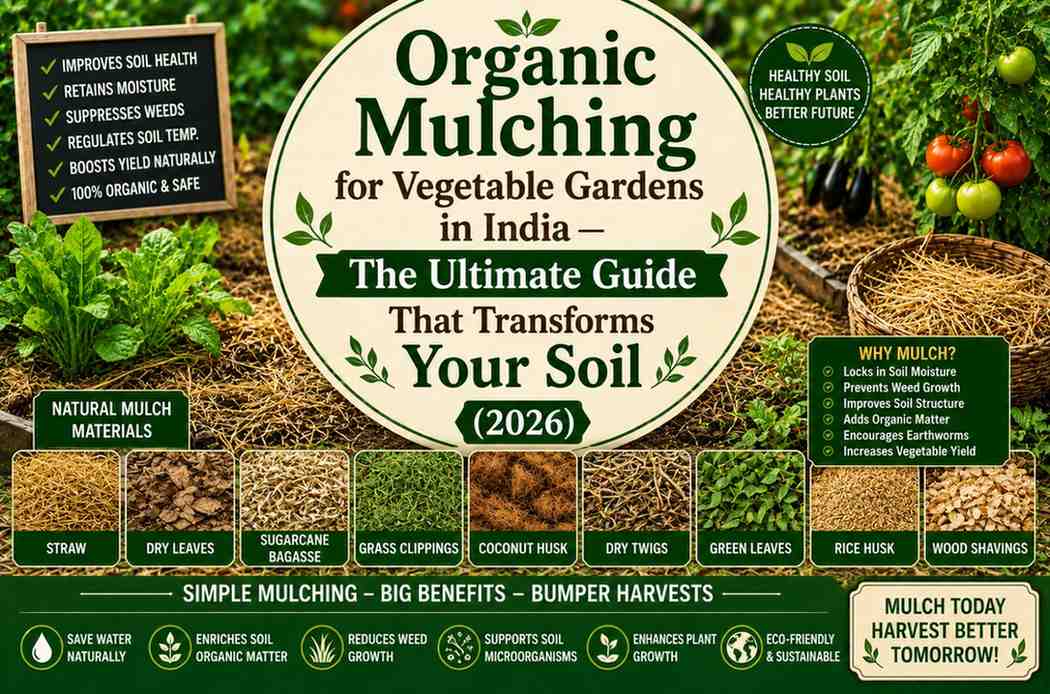
Ask any experienced organic gardener in India about the single change that made the biggest difference in their garden, and most will give you the same answer: mulching.
Organic mulching for vegetable gardens in India is one of the most powerful, low-cost, and completely natural techniques available to home gardeners—yet it remains one of the most underused. In a country where summer temperatures regularly exceed 40°C and water scarcity affects nearly every state, mulching is not optional—it is essential.
This comprehensive guide explains exactly what mulching is, which organic materials work best in India, how thick to apply them, and the remarkable transformation your vegetable garden will experience.
What Is Organic Mulching?
Mulching means covering the surface of your garden soil with a layer of material. Organic mulch is mulch made from natural plant-based materials that eventually decompose and feed your soil.
This is in contrast to synthetic mulch (plastic sheeting and rubber chips), which does not decompose and adds no nutrition.
Organic mulching for vegetable gardens in India creates multiple simultaneous benefits that every gardener needs:
- Moisture retention—reduces water loss from soil surface by 40–70%
- Temperature regulation — keeps soil cool in Indian summer heat (crucial above 30°C)
- Weed suppression — blocks light to weed seeds, reducing weed growth by 80–90%
- Soil building — as mulch decomposes, it adds organic matter and nutrition
- Erosion control — protects soil from heavy monsoon rain damage
- Pest and disease reduction—prevents soil-splash disease spread to lower leaves
- Earthworm activity — mulched soil has dramatically higher earthworm populations
The Science of Why Mulching Works
To fully appreciate organic mulching for vegetable gardens in India, it helps to understand the soil science:
In unmuzzled soil under the Indian sun:
- Soil surface temperature can exceed 55–60°C in peak summer
- Most beneficial soil organisms die above 50°C
- Water evaporates from the surface within hours of watering
- Rain impacts compact the soil surface into a hard crust (reduces water infiltration)
In mulched soil:
- Soil surface temperature stays 10–20°C cooler
- Beneficial bacteria, fungi, and earthworms thrive
- Soil retains moisture for 2–3 days longer
- A mulch layer absorbs rain impact, preventing compaction
This temperature and moisture difference is why mulched vegetable gardens in India consistently outperform unmulched ones.
Best Organic Mulching Materials for Indian Gardens
India has abundant, diverse organic mulching materials—most of them free or very cheap. Here are the best options:
1. Dry Leaves — The Most Available Mulch in India
Best material for: All vegetables; general use in any Indian garden.
Dry fallen leaves are the single most available mulching material across India. Collect them from your garden, street, or nearby parks.
Properties:
- Excellent moisture retention
- Good insulation
- Decompose slowly (6–12 months), continuously feeding soil
- Harbour beneficial insects and earthworms
How to apply: Collect and shred or tear roughly (smaller pieces decompose faster); apply 3–4 inches thick.
Best seasonal use: Most abundant in autumn and early winter. Collect and store for summer use.
Cost: Free
2. Paddy / Rice Husk (Dhan Ki Bhusi) — India’s Agricultural Mulch
Best for: All vegetables, especially in rice-growing states (West Bengal, Punjab, Andhra Pradesh, Tamil Nadu).
Rice husk is a byproduct of rice milling—available in enormous quantities across India and often given away free at rice mills.
Properties:
- Excellent moisture retention
- Very slow to decompose (high silica content)
- Does not compact or mat
- Neutral pH
- Excellent for pot gardening — lightweight
How to apply: Apply 2–3 inches around plants. Soak briefly with water after application to prevent it from blowing away.
Cost: Free to ₹5–10/kg at rice mills
3. Straw (Wheat or Paddy Straw) — Classic Vegetable Garden Mulch
Best for: Tomatoes, cucumbers, beans, root vegetables.
Wheat or paddy straw is the traditional mulch of Indian farms and one of the best options for organic mulching for vegetable gardens in India.
Properties:
- Excellent moisture retention (holds 3–4x its weight in water)
- Good weed suppressor
- Decomposes in 4–6 months, adding organic matter
- Keeps fruit (tomatoes, cucumbers) clean and off the soil
How to apply: Lay 3–4 inches around the plant’s base. Keep 2–3 cm clear of the plant stem (prevents stem rot).
Cost: ₹5–15/kg at agricultural supply shops; often free from farms after harvest.
4. Coconut Coir / Coco Peat — South India’s Versatile Mulch
Best for: Container gardening, balcony gardens, raised beds.
Coconut coir is made from coconut husk—a waste product of India’s massive coconut industry. It is lightweight, excellent for pots, and widely available, especially in South India and coastal regions.
Properties:
- Excellent moisture retention
- Natural antifungal properties (lignin content)
- Slow decomposition
- Lightweight (excellent for rooftop and balcony gardens)
- Can be reused season after season before it fully decomposes
How to apply: Spread 1–2 inches in pots or 2–3 inches in beds.
Cost: ₹80–120/block (one block covers several pots)
5. Green Leaf Mulch — Fast-Decomposing Nutrition Mulch
Best for hungry crops like tomatoes, cucumbers, and leafy greens.
Fresh, green leaves (from pruning, garden trimmings, or collected plant material) decompose fast and release nitrogen quickly.
Properties:
- Fast decomposition (2–4 weeks)
- Adds significant nitrogen as it decomposes
- Available from garden trimmings (neem leaves, banana leaves, gulmohar)
Special note on neem leaves: Neem leaves are exceptional. They contain natural pesticide compounds (azadirachtin), so using neem leaves as mulch simultaneously provides moisture control AND pest suppression.
How to apply: Lay 2–3 inches, but add more regularly as it decomposes. Combine with dry leaves for better balance.
Cost: Free
6. Newspaper / Cardboard — Urban Gardener’s Mulch
Best for: Weed suppression in new beds; balcony container gardening.
Newspaper and cardboard form an effective weed barrier and moisture-retaining layer. They break down within 3–6 months, feeding soil organisms.
Properties:
- Excellent weed barrier
- Absorbs and retains moisture well
- Biodegradable
- Free (newspapers, cardboard packaging)
How to apply:
- Wet newspaper thoroughly before laying
- Apply 4–6 sheets thick
- Cover with a layer of soil or another mulch to prevent blowing
- For cardboard: remove all tape and staples; flatten, wet, and lay
Cost: Free
7. Bagasse (Sugarcane Waste)—Available in Sugar-Producing Regions
Best for: Vegetable beds in Maharashtra, UP, Karnataka, and Tamil Nadu.
Bagasse is the fibrous residue left after sugarcane juice extraction. It is available in huge quantities from sugarcane mills and jaggery (gur) producers across India’s sugar belt.
Properties:
- Good moisture retention
- Moderate decomposition rate
- High carbon content (good browns for soil balance)
Cost: Free or very cheap at sugarcane mills.
How Thick Should You Apply Mulch?
This is one of the most common questions about organic mulching for vegetable gardens in India. The answer varies by material:
| Mulch Type | Recommended Depth | Notes |
|---|---|---|
| Dry leaves | 3–4 inches | Compress to 2 inches after watering |
| Straw / paddy husk | 3–4 inches | Don’t compact |
| Rice husk | 2–3 inches | Lightweight, won’t compress much |
| Coco peat | 1–2 inches in pots | 2–3 inches in beds |
| Green leaves | 2–3 inches | Decomposes fast—replenish regularly |
| Newspaper | 4–6 sheets | Top with another mulch |
| Cardboard | Single layer | Top with soil/mulch |
Critical rule: Always leave a 2–5cm gap between the mulch and the plant stem. Mulch piled against stems traps moisture and causes fungal stem rot.
Seasonal Mulching Guide for India
Summer (March–June) — Most Critical Season for Mulching
Apply maximum mulch thickness—4 inches of straw or dry leaves. Mulching is essential in Indian summer to prevent soil from exceeding lethal temperatures for plant roots and soil organisms.
Monsoon (July–September)
Reduce mulch to 2 inches to prevent waterlogging and slug/snail habitat. Ensure mulch doesn’t block drainage.
Winter (October–February)
Apply 2–3 inches to insulate roots from overnight cold (important in north India). In frost-prone areas, heap mulch around plant bases.
Mulching in Pots and Grow Bags
Organic mulching for vegetable gardens in India is equally important for container gardening.
- Use 1–2 inches of peat, dry leaves, or rice husk on top of your pot soil
- This significantly reduces watering frequency
- Regulates temperature in black grow bags that absorb heat
- Suppresses the moss and algae that grow on constantly wet pot surfaces
Common Mulching Mistakes to Avoid
Organic mulching for vegetable gardens
1. Mulching too close to the stem—Leave a 2–5 cm gap. Stem contact causes rot.
2. Volcano mulching — Piling mulch high around the stem like a volcano is harmful. Keep it flat.
3. Too thin—Less than 2 inches is ineffective. Weeds push through, and moisture evaporates.
4. Too thick (for fine materials)—6+ inches of fine materials like coco peat can become hydrophobic when dry, repelling water.
5. Fresh, nitrogen-rich green mulch only—Using only green plant material can create a nitrogen deficit in soil temporarily. Balance greens with dry/brown materials.
6. Mulching dry soil—Always water your garden thoroughly BEFORE applying mulch. Mulch locks in moisture—if soil is already dry, it locks in drought.
IMAGE SUGGESTION 1:
Placement: After the “Best Materials” section Description: Close-up of dry leaf mulch applied around tomato plants in an Indian raised-bed garden ALT Text: “organic mulching for vegetable gardens in India—dry leaf mulch around tomato plants”
IMAGE SUGGESTION 2:
Placement: After the thickness guide table Description: Indian balcony garden with grow bags mulched with peat and straw, with thriving vegetable plants. ALT Text: “Organic mulching for vegetable gardens in India—grow bags mulched with peat in a balcony garden.”
Authority External Resources
- National Centre of Organic and Natural Farming — Mulching Guide — Indian government guidance on organic mulching practices.
- ICAR — Mulching Research India — Research on mulching effectiveness in Indian agricultural conditions.
- Rodale Institute — Mulching Organic Gardens — World-leading research on organic mulching methods.
- FAO — Soil Mulching — International resource on soil mulching science and application.
- Down to Earth — Indian Organic Practices — India-focused environmental coverage, including organic gardening practices.
FAQs: Organic Mulching for Vegetable Gardens India
Q1. Does mulching attract pests like snails, slugs, or rodents? Moist mulch can harbor slugs and snails—a concern particularly in humid coastal regions of India. Mitigate this by keeping mulch away from stems, maintaining good garden hygiene, and using neem leaf mulch (naturally pest-deterring). Diatomaceous earth dusted around the mulch perimeter also controls slugs.
Q2. Should I remove mulch before applying fertilizer? No. Pull mulch gently aside, apply fertilizer to the soil surface, water it in, and then replace the mulch. Alternatively, liquid fertilizers (like compost tea or Jeevamrut) can be applied directly through the mulch layer—they percolate through easily.
Q3. Can I use kitchen paper towels as mulch? Plain white kitchen paper towels (unbleached, without plastic coating) can be used in a pinch—they decompose quickly. Avoid colored or heavily treated papers. Newspaper and plain cardboard are better choices for a more lasting mulch layer.
Q4. How often should I add fresh mulch? Fast-decomposing mulches (green leaves and fresh straw) need replenishing every 3–4 weeks. Slow-decomposing mulches (dry leaves, rice husk, and coco peat) need replenishing every 2–3 months. Inspect regularly and top up when the layer falls below 2 inches.
Q5. Does mulching work for potted plants on apartment balconies? Absolutely! Mulching is perhaps even more important for pots than for ground gardens, because pots dry out much faster. A 1–2 inch layer of coco peat or rice husk on the surface of a pot can reduce watering frequency by 30–50%, a significant benefit for busy urban gardeners.
Conclusion
Organic mulching for vegetable gardens in India is not an optional extra—it is a fundamental practice that defines whether your garden thrives or merely survives.
In India’s challenging climate, where summer temperatures fry soil and monsoon rains compact it, mulching is the single most protective and productive thing you can do for your vegetable garden.
Start simply: collect dry leaves from your street or compound, apply a 3-inch layer around your plants, and water them in. Within two weeks, you’ll notice your soil retaining moisture longer, your plants growing more vigorously, and your watering needs dropping significantly.
Your plants will thank you. Your soil will reward you. And your water bill will go down too. Start mulching today.