 editer@organickheti.in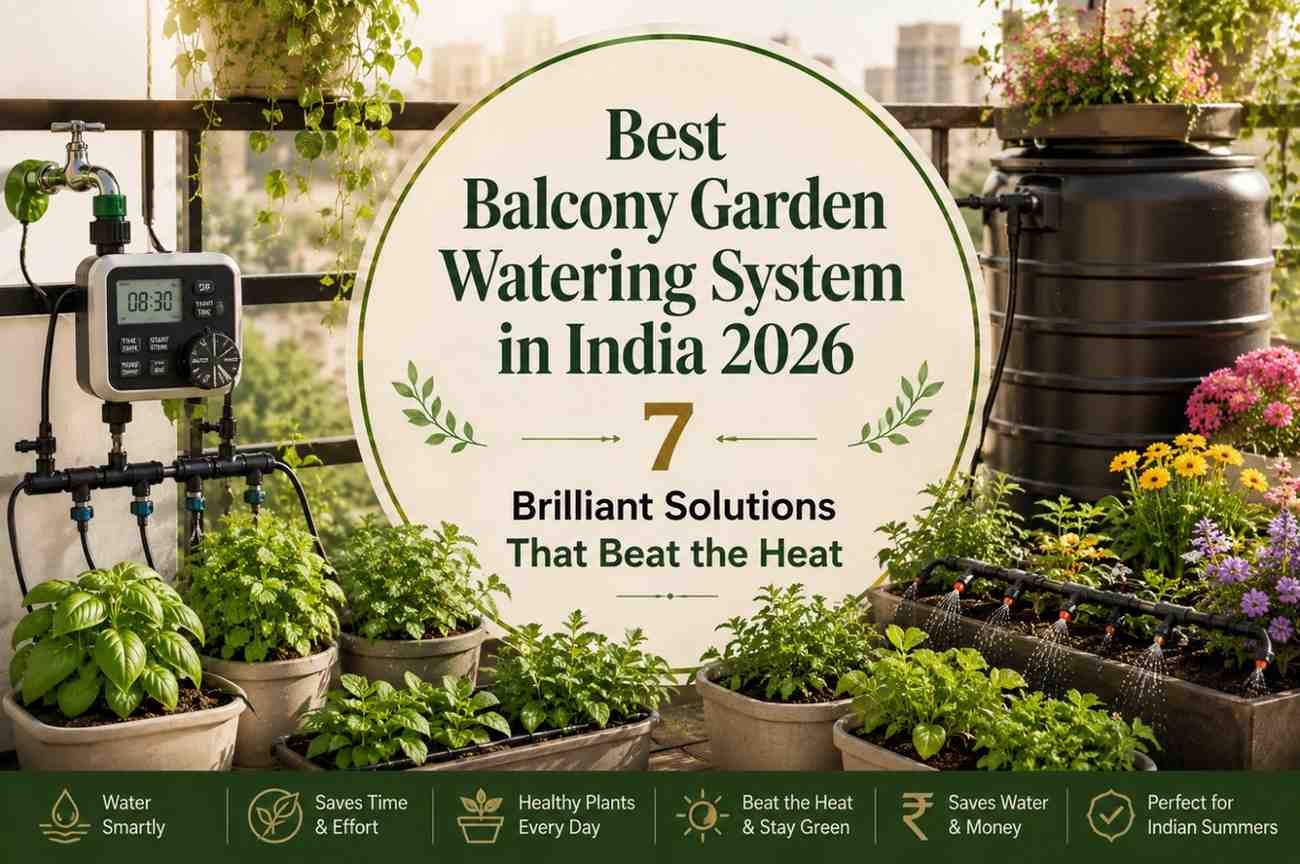
Introduction
The single most common reason Indian balcony gardens fail is not poor soil, wrong plant choice, or lack of sunlight—it is inconsistent watering. Plants either dry out during a summer heatwave or get waterlogged during the monsoon. Solving this problem with a well-designed balcony garden watering system in India 2026 is the difference between a thriving garden and a collection of wilting disappointments.
This guide covers every proven option—from high-tech drip irrigation setups to brilliant low-cost DIY solutions—so you can find the right balcony garden watering system India in 2026 approach for your space, budget, and lifestyle.
Why Watering Is the Biggest Challenge for Indian Balcony Gardens
Before choosing the right balcony garden watering system in India 2026 setup, it helps to understand exactly what makes balcony watering so demanding in India.
Extreme heat and evaporation: During April–June, temperatures in cities like Delhi, Nagpur, and Hyderabad regularly exceed 42°C. Container soil in black or dark-colored pots can reach 50°C at the surface, causing rapid moisture evaporation. A pot that stays moist for 3 days in October may dry out completely within 12 hours in May.
Busy urban lifestyles: Many Indian apartment dwellers travel for work, take weekend trips, or simply forget to water regularly. Missing even 2 consecutive days of watering during peak summer can kill sensitive plants like coriander, spinach, and basil permanently.
Monsoon overwatering: Between July and September, daily heavy rainfall can waterlog containers that lack adequate drainage—causing root rot, fungal infections, and plant death. A good balcony garden watering system in India in 2026 must manage both under-watering and over-watering risks.
Water pressure variability: Many Indian apartments experience low or intermittent water pressure, especially in the morning when building demand peaks. Drip systems that rely on consistent pressure need pressure compensation to function reliably.
Option 1: Micro Drip Irrigation Kits — The Most Efficient Choice
Drip irrigation is widely regarded as the gold standard for a balcony garden watering system in India in 2026. It delivers water directly to the root zone, eliminates leaf wetting (which causes fungal disease), and uses 30–50% less water than hand watering.
How it works: A central heater hose connects to a water source (tap or tank). Thin distribution tubes branch out from the header to individual pots, each ending in a small dripper or emitter that releases water at a controlled rate (typically 1–4 liters per hour).
Best kits available in India in 2026:
- Netafim Micro Drip Kits — Israel-origin brand with Indian distribution; highly reliable pressure-compensated drippers suitable for high-rise balconies
- Rivulis Micro Irrigation Sets — Affordable and widely available online; good for setups of 10–30 pots
- Local DIY kits from Jain Irrigation—Jain Irrigation Systems offers affordable drip components that can be custom-assembled for any balcony layout
Timer integration: Pair any drip kit with a battery-operated tap timer (available on Amazon India for ₹800–₹2,500) to create a fully automated balcony garden watering system in India 2026 that runs without any daily intervention. Set it for early morning (5:30–7:00 AM) when evaporation is lowest.
Setup cost: ₹1,200–₹4,000 for a 10–20 pot system. Water savings: Up to 50% compared to hand watering Ideal for: Tomatoes, chillies, brinjal, okra, and fruiting vegetables
Option 2: Self-Watering Pots (Sub-Irrigation Planters)
Self-watering pots are one of the most practical innovations in the balcony garden watering system in the 2026 India landscape, especially for time-pressed urban gardeners.
How they work: Self-watering pots have a built-in reservoir at the base separated from the growing medium by a wicking chamber. The plant draws water upward by capillary action as needed, taking exactly as much moisture as required and no more. You simply fill the reservoir once every 3–7 days (depending on pot size and season), and the plant manages its own hydration.
Why they excel in Indian conditions:
- Eliminate overwatering and underwatering simultaneously
- Reduce watering frequency to 2–3 times per week even in peak summer
- Keep root zones consistently moist without waterlogging
- Reduce evaporative loss by up to 60% compared to top-watered pots
Best self-watering pot options for India in 2026:
- Lechuza Planters (imported, premium, available online) — excellent for balcony aesthetics and long-term durability
- Ugaoo Self-Watering Pots — Indian brand, affordable, available in multiple sizes
- DIY conversion—any standard pot can be converted using a 2-litre cut PET bottle as a reservoir inserted through the drainage hole
Ideal for: Herbs (especially mint and basil), leafy greens, strawberries, and any plants requiring consistent moisture.
Option 3: Clay Pot Irrigation (Matka / Surahi Method)
This traditional Indian irrigation technique deserves a prominent place in any balcony garden watering system India 2026 guide because of its elegant simplicity and remarkable effectiveness.
How it works: An unglazed clay pot (matka or surahi) with a small hole or porous walls is buried or placed at soil level in your garden bed. Filled with water, the clay slowly seeps moisture into the surrounding soil over 24–48 hours. Plant roots actively seek out the moisture plume, growing toward the clay pot.
Modern adaptations for balcony use:
- Use small unglazed terracotta ollas (available at pottery markets) placed in larger containers
- A DIY version uses two unglazed terracotta pots sealed together at the rim—fill through a small hole at the top
- Traditional surahi clay jugs work beautifully as slow-release water reservoirs in raised beds
Efficiency: Reduces water use by up to 70% compared to surface watering—the most water-efficient option in the balcony garden watering system in India 2026 toolkit.
Cost: ₹50–₹300 per unit depending on size Ideal for: Raised beds, deep containers, tomatoes, and drought-tolerant herbs
Option 4: Wick Watering Systems (Passive Irrigation)
Wick watering is a brilliantly simple passive balcony garden watering system in India 2026 method that requires zero electricity, no timers, and almost no maintenance.
How it works: A cotton or nylon rope (wick) draws water by capillary action from a reservoir (bucket, bottle, or jug) through the drainage hole at the bottom of a pot. The wick maintains consistent moisture in the lower 5–8 cm of soil, whose roots actively colonize.
DIY setup:
- Use 0.5 cm diameter cotton rope cut to 30–40 cm length
- Thread through the drainage hole of the pot before filling with soil mix
- Submerge the other end in a water container placed slightly below the pot level
- A single 5-litre container can sustain a medium pot for 4–7 days
Best application in a complete balcony garden watering system in India 2026 setup: Use wick systems for travel periods or weekends away when automated drip systems are not practical.
Cost: Under ₹100 | Ideal for: Herbs, leafy greens, seedlings
Option 5: Smart Tap Timers and Soil Moisture Sensors
For Indian apartment gardeners who want a genuinely intelligent balcony garden watering system in in India 2026, combining a programmable tap timer with a soil moisture sensor is the ultimate setup.
Programmable tap timers: These battery-operated devices attach directly to your tap and open/close a valve on a set schedule. Look for models with:
- Multiple daily watering windows (important for summer double-watering)
- Rain delay sensors (critical for monsoon season)
- Manual override (for flexible watering needs)
Recommended brands available in India: Raindrip, Orbit, and Melnor timers are available through Amazon India at ₹1,200–₹3,500.
Soil moisture sensors: Wireless capacitive soil sensors (like those from Xiaomi or INKBIRD) measure real-time soil moisture and connect to your smartphone via Bluetooth or Zigbee. Set threshold values—”water when moisture drops below 40%”—and pair with a smart valve for fully automated, demand-based irrigation.
This tech-integrated approach to the balcony garden watering system in the India 2026 context is especially valuable in cities like Bengaluru and Pune, where water rationing schedules make predictable watering difficult.
Option 6: Gravity Drip Bottles (Zero-Cost Solution)
For gardeners on a tight budget, inverted plastic bottle drip feeders are a highly effective balcony garden watering system in India 2026 solution that costs virtually nothing.
How to make them:
- Clean a 1-litre or 2-litre PET bottle thoroughly
- Poke 3–4 small holes (use a hot needle) in the cap
- Fill the bottle with water and screw the cap on tightly
- Invert and push the bottleneck 5–8 cm into the soil of a medium-sized pot
The water drips slowly through the punctured cap over 24–48 hours, depending on soil dryness. Multiple bottles in adjacent pots create a low-tech drip grid.
Enhancement: Add a small amount of liquid fertilizer (jeevamrut or diluted seaweed extract) to the water bottle to combine irrigation and feeding in one operation.
Ideal for: All pots during 2–3 day absences | Cost: ₹0 (upcycled materials)
Building the Complete Balcony Garden Watering System for Indian Conditions
A truly robust balcony garden watering system in India in 2026 typically combines multiple approaches for different plants and situations. Here is a recommended integrated setup:
Tier 1—Daily watering (automated): Install a micro-drip kit with a timer for tomatoes, chilies, and fruiting vegetables. Set for 6:00 AM daily (double frequency in summer).
Tier 2 — Self-managed moisture (passive): Use self-watering pots or wick systems for herbs and leafy greens that require consistent moisture.
Tier 3 — Emergency backup (DIY): Keep a supply of inverted water bottles for use during travel, power cuts, or equipment failure.
Monsoon management: Move shade cloth or temporary roofing over beds during heavy rain. Ensure all pots have drainage holes completely clear and unobstructed. Reduce or pause automated drip systems during extended monsoon periods.
Water Conservation Tips for Indian Balcony Gardens
Integrating water conservation into your balcony garden watering system in India 2026 is increasingly important given rising water scarcity across Indian cities.
- Collect AC condensate water—an air conditioner running for 8 hours produces 2–5 litres of near-distilled water ideal for plants
- Use mulching in containers—a 3 cm layer of dry leaves, cocopeat, or straw on pot surfaces reduces evaporation by 40–50%
- Group pots together—clustered pots create a microclimate of higher humidity, reducing individual plant water demand
- Water at root level — use narrow-spout watering cans or drip tubes to deliver water directly to root zones rather than leaves
Frequently Asked Questions (From Google)
Q1: What is the best watering system for balcony plants in India? A micro-drip kit paired with a programmable timer is the most efficient and reliable option for most Indian balcony gardens. It automates watering, conserves water, and adapts to seasonal needs—making it the centerpiece of any modern balcony garden watering system in India 2026 setup.
Q2: How do self-watering pots work in Indian summer heat? Self-watering pots work exceptionally well in Indian heat because the subsurface reservoir protects water from direct evaporation. They typically need refilling every 3–5 days in summer versus 6–8 days in winter, making them far more reliable than surface-watered pots during heatwaves.
Q3: Can I use drip irrigation on an apartment balcony without a garden tap? Yes. You can connect drip kits to standard kitchen or bathroom taps using flexible hose connectors. Alternatively, use a gravity-fed tank (an elevated bucket or container) as the water source—no tap connection required.
Q4: How do I water my balcony plants while on vacation? Use a combination of self-watering pots, inverted bottle drippers, and wick systems for absences of 3–7 days. For longer trips, a timer-controlled drip system is the most reliable option. Group pots together and apply thick mulch before leaving.
Q5: Is drip irrigation worth the investment for a small balcony garden? Absolutely. Even for 10–15 pots, a basic drip kit pays for itself within one growing season through water savings, reduced plant loss, and dramatically less time spent on daily watering—particularly valuable in the context of a busy Indian urban lifestyle and the unique demands of a balcony garden watering system in India 2026 setup.
Conclusion
Building the right balcony garden watering system in India in 2026 is the single most impactful upgrade any Indian balcony gardener can make. Whether you invest in an automated drip system, install self-watering pots, or use simple clay pot irrigation, the result is the same — healthier plants, dramatically reduced daily effort, and a garden that thrives even through India’s most challenging seasons.
Start with one method, observe how your plants respond, and expand from there. The goal is a garden that nearly takes care of itself while you enjoy the harvest. Explore more about modern drip irrigation solutions for Indian home gardens at Jain Irrigation Systems.